Tag Archives: history

“I Won’t Take Anything Off of Anybody”

Clady F. Johnson was born in 1902 in Stokes County, N. C., the eighth child of Lindsay Johnson and Martha White.

The following article about Clady appeared in the Western Sentinel newspaper in April of 1921:

“Clady Johnson Sent to Roads for Month:

“Can’t you get a job?  asked Judge Hartman of a young white man in the city court this morning, who was on trial for being a vagrant.  ‘I can,’ was the reply, ‘but they won’t pay over $1.50 a day, and before I’ll work for that, I’ll go to the county roads.’

“‘Thirty days,’ said the judge.

“‘I understand you are a rather hard sort of a fellow,’ said the judge, and the young man replied:

“‘I am one of these fellows that loves a fight when I get started.  No, sirree, I won’t take anything off of anybody.’

“The young man’s replies to the court were rather abrupt.

“The defendant’s name was Clady Johnson, and he was arrested last night and held in jail until this morning.”

Clady’s Story—Low Wages

When Clady was about 17 years old, his parents moved from a farm in Stokes County, N. C.,  to Winston-Salem. There he, his brother Jim, and their father  worked at R. J. Reynolds Tobacco Co.  Clady was able to read and write, and he had a third-grade education.

While living in Winston-Salem, Clady apparently quit his job in the cigarette factory, unhappy with the low wages.  In the 1920’s, a young man with no occupation could easily be accused of being a vagrant, by loitering in public places, possibly drinking (in the time of Prohibition) or fighting.

$1.50 for a day’s work (in 1921 usually nine hours) averages out to 16 cents per hour.  Sixteen cents back then had the buying power of $2.85 in 2025, so far from a living wage that no wonder Clady refused to accept it.

In the labor market then, race and gender affected wages, just as they do now, but with more extremes. In the tobacco industry in Virginia in 1928, the highest wage was paid to white men, at 53 cents/hour.  The wage dropped to 31 cents for white women, 29 cents for black men, and 16 cents for black women. 

Black women were the largest group employed by R. J. Reynolds, and perhaps this affected the rate of pay, even for white men, who could easily be replaced by much cheaper labor.

In the many textile factories in the area, things were no better.  The average hourly earnings for a male in the cotton textile industry in North Carolina in 1920 was about 50 cents.  In 1922, it actually fell, to 30 cents.  There was a major economic recession in 1921 and many newspaper articles report cuts in industrial wages.  Fifty cents was still more than Clady claimed to be paid at RJR.  In fact, he was earning less than half the national average for a factory worker in the U. S. in 1921.

Working on the Chain Gang

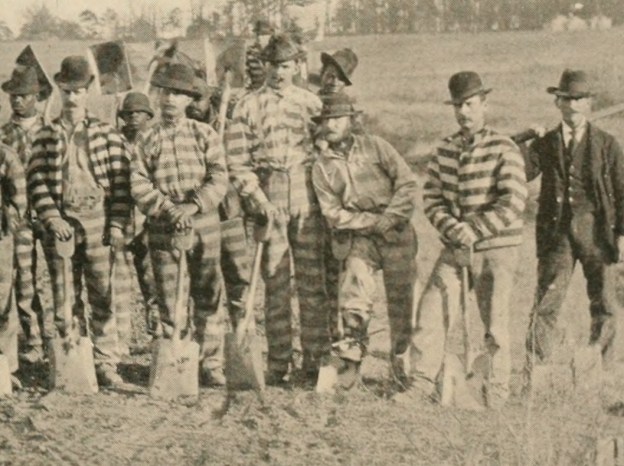
Clady’s bravado in telling the judge he’d rather work on the roads may have been reduced quite a bit by the reality of working on a chain gang.  Chain gangs were the low-cost solution to road building and maintenance until the 1950’s.  Just like in the movies, the men were dressed in black and white striped uniforms and had iron shackles on their ankles joined by a chain short enough to prevent them from running.  They were housed in temporary camps located near their work site, in all weathers, guarded by men with shotguns, and flogged for misbehavior.  They worked with picks and shovels, doing hard labor that is now done by machines.

Clady’s change in attitude was revealed when his name appeared in the newspaper again, this time in a list of thirty-three white men who had escaped the chain gang over a ten-year period.

Life Afterward

The family moved to Mt. Airy soon afterward. In 1930, Lindsay Johnson was no longer working and his three youngest sons were all working in a furniture factory, Clady, as a sprayer.  Lindsay died in 1931 at age 70 and Martha died in 1933. 

By the 1940 census, Clady was living with his youngest sister, Mary, in Washington, D. C.  He was unemployed and unable to work.  His brothers Elijah and John, also living in Mary’s household, both registered for the WWII draft.  Clady apparently never registered, perhaps because of his health, and he died in 1941 of respiratory illnesses.

Sources:  

The Western Sentinel (Winston-Salem, N.C.) Apr 23, 1921, p. 17.  “Clady Johnson Sent to Roads for Month.”

“Winston-Salem Journal,  Dec. 15, 1922, p. 4. “Reward Offered for Runaways,”

Journal Article, “Wage Rates and Hours of Labor in North Carolina Industry,” H. M. Douty; Southern Economic Journal, Vol. 3, No. 2 (Oct., 1936), pp. 175-188.

Federal Reserve Bank of St. Louis: FRASER Newsletter, July 1930, Volume 31, Number 1, Date: July 1930. https://fraser.stlouisfed.org/title/monthly-labor-review-6130/july-1930-608191?page=176

https://www.myamortizationchart.com/inflation-calculator/], accessed 10 July 2025.

 U. S. Bureau of Labor Statistics/Data Tools/Charts and Applications/Inflation Calculator; https://www.bls.gov/data/inflation_calculator.htm, accessed 4 June 2025.

Handbook of labor statistics / U.S. Department of Labor, Bureau of Labor Statistics 1936,  Accessed online on 4 June 2025, at https://babel.hathitrust.org/

1910 U.S. Census, Quaker Gap, Stokes County, N. C.; NARA Microfilm # T624-1128; Enumeration District 182, p. 2B.

 1920 U.S. Census, Winston Township, Forsyth County, N. C.; E. D. 90, pp.  8A-8B.

Winston-Salem, N. C., City Directory, 1921, p. 279; Ancestry.com. U.S. City Directories, 1821-1989, database on-line.

Ernest H. Miller, Miller’s Mount Airy, N. C. City Directory, Asheville NC:  Southern Directory Co., 1928-1929, pp. 170-171.

1930 U.S. Census,  Mt. Airy township, 2nd Ward, Surry County, N. C., ED 86-12,  “Lindsay J. Johnson” family, p. 3B.

1940  U. S. Census, Washington, D. C., Block 15, E. D. 27B, p. 61B; April 9, 1940; accessed on ancestry.com.

Certificate of Death of Clady Johnson, March 7, 1941, District of Columbia, Health Dept., Bureau of Vital Statistics.

Veteran’s Day Reflections

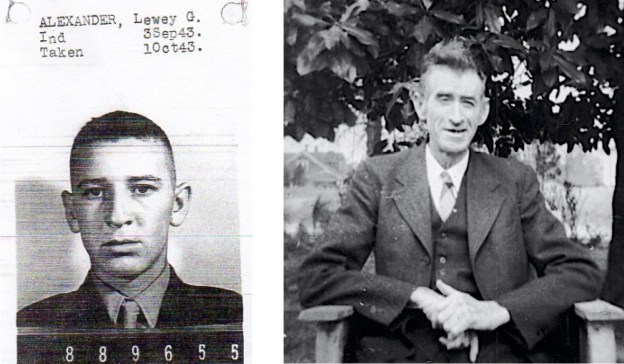
During World War II, my father (pictured on his military i. d., above at left) and three of his brothers and two brothers-in-law all served in the armed forces. All survived the war. However, the family lost both parents during war-time. My grandmother, Loula Alexander, died in February of 1943, and then my grandfather, Frank Alexander, (pictured at right above, 1945) was diagnosed with lung cancer and died in 1945.

A document filed with my father’s military records reveals a lot about the family’s situation.

The Servicemen’s Dependents Allowance Act of 1942 provided allowances for the support of the families of soldiers. Class B covered parents and siblings who were dependent on the soldier. The allowance for one parent was $15 per month, plus an additional $5 for each sibling, not exceeding $50 per month. The deduction from the soldier’s pay was $22 per month.

A Dependency Affidavit filed by Frank Alexander January 3, 1945, stated “Due to ill health I am confined to bed and unable to support myself and children.” He was age 64 and lived in Vass, N. C. His wife had died in February of 1943. The affidavit certified that he was dependent on a serviceman for more than half of his income, and asked for a Class B-1 family allowance.

Frank had two dependent children living at home, Max and Patsy Lou, who were both in school. Frank had $140 in the bank and had received $200 in “allotments” from his son, PFC Lewey Alexander, since September of the previous year. Lewey (called Tuppin by the family,) was age 20 and unmarried. Frank’s son Jack was age 30, married and serving in the Army, and son Robert, age 17 and single, was in the Merchant Marine.

At that time, Frank and his children lived in a house that he owned in the town of Vass. The house and lot were worth $1000. He had an additional 82 acres of land, also worth $1000. From the estate of his wife he had inherited $2300 worth of stock in the Carolina Power and Light Company. He was debt-free.

In 1942 and 1943, Lewey had worked on the farm, helping to raise crops during his vacation from college (Lees-McRae.) After enlistment in the U. S. Marines in 1944, he contributed $50 per month to his family’s income. Frank had become unable to work and only Lewey was able to contribute to the family income.

Additional notes:

Frank died eight months later, on August 4 of 1945. He had eight surviving children, including two older, married daughters, and a son, John Alexander, who survived the attack on Pearl Harbor in 1941 and received a medical discharge in 1942. John was married, and his first child was born a week after the affidavit was signed.

Upon requesting my father’s military records from World War II, I learned that a fire at the National Personnel Records Center in 1973 destroyed most of them. You can request copies of documents online through the E Vet Records application, but the local V. A. helped me apply for the few records that are left from other sources.

Sources:

“Lewey Glenn Alexander Dependency Affidavit,” Jan. 3, 1945; NARA.

https://www.ssa.gov/policy/docs/ssb/v6n7/v6n7p21.pdf, acceded 9 Nov. 2024; Administration of the Servicemen’s Dependents Allowance Act; https://maint.loc.gov/law/help/statutes-at-large/77th-congress/session-2/c77s2ch443.pdf, publication on Library of Congress website.

“The 1973 Fire, National Personnel Records Center,” https://www.archives.gov/personnel-records-center/fire-1973, accessed 9 Nov. 2024.

Family Records in the possession of the author.

A Slice of Life: 1876

On Friday, August 18, 1876, page four of the Charlotte Observer reported that “The house of Mr. Smith Alexander, in Sharon Township, was entered last Tuesday while the family were absent attending a picnic, and robbed of clothing, meat, flour and everything that could be conveniently carried away.”

Mr. (John) Smith Alexander was 50 years old, and had been married for almost three years to Maggie Stilwell, age 29. They had lost their first child, Julia, the previous year, and in less than two months, Maggie would give birth to their second child, Oscar.

Other articles on the same page of the newspaper give some clues as to what life was like in 1876, as well as what type of picnic they might have been attending. A picnic promoting Temperance, or abstinence from drinking alcohol, was advertised. Temperance was a hot topic in the 1800’s, especially with women whose husbands overindulged and wasted the family’s livelihood and sometimes, became violent when under the influence.

Pills to remedy drinking too much were advertised, as well as a remedy for Dyspepsia, which apparently included all gastrointestinal complaints.  Many ads for patent medicines listed the common illnesses of the time, including tuberculosis, whooping cough, and dysentery.

Several other articles were about picnics and rallies for the political candidates of the period. Zebulon Vance was running for State Governor, again, after serving during the Civil War and spending some time after the war under arrest. The lyrics for a campaign song for Vance were printed on the page, so it would seem that the Observer promoted his candidacy. The Sharon and Steel Creek communities were both mentioned as sites of political rallies.

The articles included many racist remarks.  The Reconstruction period that followed the Civil War lasted until about 1876.  The Democratic Party was the more conservative of the two main political parties.  The Republican party had been the party of President Lincoln.  One article remarked that the Republicans called the newspaper Democratic.

The hard times that followed the war were mentioned. Financial news and grocery ads indicated that bacon, corn, lard, flour, chickens, eggs, butter, honey, and sugar were important items in the diet of the times, and some foods, such as chickens, eggs, and butter, were scarce.  Also mentioned were prices for cheese, rice, meal, grits, molasses, coffee, tea, fish, oats, peas, fruits, and potatoes, as well as wines and liquors.

Ads in the “Ten cent column” cost ten cents per line, minimum twenty-five cents, and included ads for Miss Mary Watson’s school, a gold mine for sale in Huntersville, food, medicine, employment, hotels, and Mason jars.

The robbers were arrested and charged, but the article didn’t mention whether any of the stolen goods were recovered. It seems significant that food was prominent in the list of things taken. For many citizens of North Carolina, the period after the war was a hungry time.

Smith and Maggie would eventually have a total of five children, one of whom was my grandfather, William Franklin Alexander, who was born in 1880. When their children were teenagers, the couple moved to a home on the Deep River in Moore County, N. C., where Smith passed away in 1904, and Maggie, later in 1931.


Sources:  The Charlotte Observer, Charlotte, North Carolina, Friday, August 18, 1876, p. 4, accessed online; “Zebulon Vance,” https://historicsites.nc.gov/all-sites/zebulon-b-vance-birthplace/history/zebulon-vance, accessed 16 Sept. 2024.


A Millwright in the Family

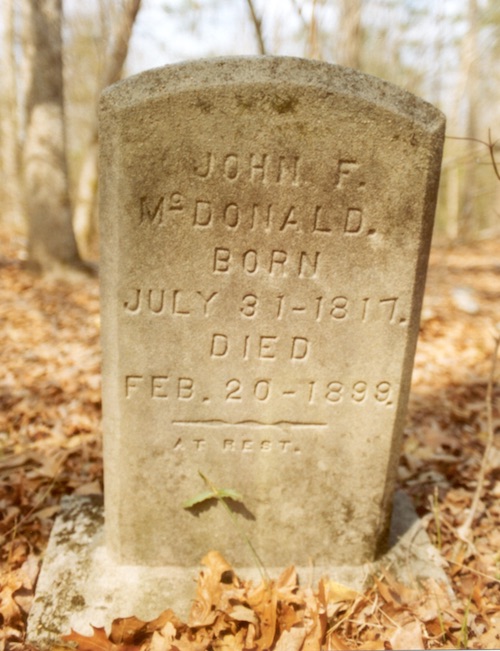
John Finlayson McDonald’s grave stone establishes his birthdate as July 31, 1817. His parents were Angus McDonald and Mary Finlayson of Cumberland County, N. C.

Both Gaelic and English were spoken in the home when John was young, and the members of his family were literate. The census tells us he became a millwright. Millwrights were the engineers of their time, needing skills for working with metal, stone, and wood, and having the knowledge and ability to create the moving parts of the mill. The work required mathematical and engineering knowledge, evidence he had some formal education.

In 1838, when John was age 21, he acquired a farm located between Carthage and Vass. He had 65 acres of land located on both sides of the Lower Little River in Cumberland County, and 100 acres adjoining the Moore County line and his father’s property lines on the river.

In 1848, John F. McDonald bought from Daniel McLeod for $850, 496 acres between Herd and Crain’s Creeks, with enough “land on the North side of Herds Creek as would be necessary for the use of a Mill and overflowing of a pond.” In Branson’s N.C. Business Directories, his name can be found in a list of “Prominent Farmers,” with 500 acres on Crains Creek.

John’s father died before the 1850 census. At that time, his mother lived in the Western Division of Cumberland County on $300 worth of real estate; his three sisters lived with their mother. A millwright named John McDonald, in the neighborhood of 33 years old, lived in the household of a widow with eight children, whose name was Edith Page.

Calculating by age of his oldest son, Angus, John Finlayson McDonald was married to Sarah Strickland around 1857. She was 22 to her husband’s 40 years of age. They had a second son, Malcom Daniel, in 1859, and unfortunately, Sarah died in childbirth. Their infant son was raised by John’s sisters, Sarah, Margaret, and Christian. Angus, their older child, can be found in census records with his father. The family belonged to Cypress Presbyterian Church in Harnett County. John’s mother, Mary Finlayson McDonald, also died sometime between 1850-1860.

John was about 45 years old in 1862, when enlistment for the Confederate Army started. It is likely that he was the John McDonald of Company H of the 6th Regiment, N. C. Senior Reserves, who served in the Civil War until its end in 1865.

About 1866, John married again. Jennet Isabella Patterson was born around 1848 in Cumberland County, and married John, a 49-year-old widower, at about age 18. The Patterson family belonged to Union Presbyterian Church, located between Carthage and Vass, where John became a member.

Their first child, Mary Arabella McDonald, was born in 1867. Their son, Neill Archibald McDonald, was born in 1869. In 1870, their home was in the Greenwood Township of Moore County. John was a millwright whose real estate at that time was valued at $800. Son Angus was age 12 and attended school. The family had neighbors who were farmers, (two who were born in Scotland,) with surnames McDonald, McLean, and Kelly.

Daughter Margaret Anne was born in 1872. Jennet’s father, Neill Patterson, died in 1877.

In 1880, the family, still in Greenwood, included the parents and four children. John was still a millwright, Angus worked as a house carpenter, and Neill was a laborer. John’s son Malcom lived with John’s sister, Christian McDonald, in Cumberland County.

In 1891, Jennet’s mother, Margaret McLean Patterson, died and was buried beside her husband at Union Presbyterian Church.

In 1899, John Finlayson McDonald died and was buried in the Ferguson and McDonald family cemetery near Crain’s Creek. His monument reads: “John F. McDonald; Born July 31–1817. Died February 20–1899. At Rest.” There is a grave to his right marked at head and foot by round field stones, which is the likely resting place of Jennet, who died soon after, in 1901. Their daughter Margaret Ann Hicks and three of her children, as well as their grand-daughter, were later buried in adjacent graves.

Sources:

Alex M. Patterson, Highland Scots Pattersons of North Carolina and Related Families. (Raleigh: Contemporary Lithographers, Inc., 1979), pp. 159-194. Patterson researched the family of John’s second wife, Jennet Isabella Patterson.

1820 U. S. Census; Moore County, N. C., page stamped 298/handwritten 301; NARA Microfilm M33_80.

James Vann Comer, Gone and Almost Forgotten: Crain’s Creek Community, (Sanford: James Vann Comer, 1986), p. 104; census records below.

Son Neill McDonald in 1940 U. S. Census, High Point, Guilford County, N. C., NARA Roll: M-T0627-02921; p. 6B; Enumeration District: 41-90.

1850 U. S. Census, Eastern Division, Cumberland, North Carolina; Roll: 627; Page: 64b; Line Number: 40, Dwelling Number: 1045, Family Number: 1058.

1860 U. S. Census, Moore County, N. C., p. 79; NARA Microfilm M653-906.

Confederate North Carolina Troops: 6th Regiment, North Carolina Senior Reserves, accessed Feb. 1, 2012 at http://www.itd.nps.gov/cwss/regiments.cfm, no date; Weymouth T. Jordan Jr., North Carolina Troops, 1861-1865 : a Roster, Vol. 12, (Raleigh, N.C. : State Dept. of Archives and History, 2004) p. 68.

1870 United States Federal Census, Greenwood Township, Moore County, N. C., p. 34; NARA Microfilm M593-1149.

1880 U. S. Census, Greenwood Township, Moore County, N. C., Enumeration District 133, p. 4D.; NARA Microfilm Roll 973, accessed online at ancestry.com

Visit to cemetery located off County Road 1825, approx. .4 mile from Highway 1, just North of Crains Creek, Moore County, with Lewey Alexander Sr., great-grandson, and William Wilson, great-great grandson, on March 29, 2002. See Findagrave Cemetery ID: 2282051.