
Stonewall Jackson
Smith’s children passed down several stories about his experiences in the Civil War. One story was that he was a “private courier” for Stonewall Jackson.1
Smith was an officer in the local militia company in the Sharon Church community of Mecklenburg County, N. C., and was therefore not eligible for the first Confederate army draft. Key members of the militia were kept as a “Home Guard” for the protection of the community. When Smith later enlisted, in March of 18632, General Jackson was only one month from his death by gunshot from his own soldiers, and Smith’s regiment didn’t serve under him. However, Jackson’s wife, Anna, was the daughter of Rev. Robert Hall Morrison, a prominent Presbyterian minister in Mecklenburg County and first president of Davidson College.3 Perhaps the courier duty that Smith served was to carry private messages between the general and Mrs. Jackson’s family.
His children said that he had a bad knee from a gunshot wound. His war records reveal that he spent some time in Winder hospital in Richmond, in September of 1863.4
Freemasons Help Each Other Survive the War
I heard two versions of the most interesting story about Smith’s military service:
The first account supposedly happened either to Smith or one of his brothers. He was circling a large oak tree, with a single Yankee soldier on the opposite side. When either of them got a chance, he fired at the other, taking cover behind the tree. The Confederate took a hit on the hand, which resulted in the loss of a thumb. Though he must have been in pain and shock, he kept fighting. Probably at this point the battle became, not an effort to kill the enemy, but an effort to survive. As time passed and neither gained the advantage, one of them called out, “If we keep on like this, both of us are going to die. What if I walk off one way and you go off in the other, and we both live?” And so they did.
Smith was not missing a thumb in his later years, so this either was not true or it happened to someone else.
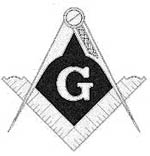
The second version, (and possibly a separate incident) is that Smith, who had a reputation for being able to “thread a needle” with a .36 caliber pistol, gained the advantage over the Union soldier, though both were wounded. The Yankee was on the ground under the muzzle of Smith’s gun. When he was about to fire, the man made a secret sign that revealed he was a Freemason. The bond between Freemasons must have been stronger than the enmity between Confederate and Union soldiers, because Smith helped the man to his feet and let him go. The Yankee walked North and Smith walked South, and they never saw each other again.5
Civil War literature contains a number of similar stories about Freemasons. Soldiers on opposite sides sometimes treated one another with respect on account of their bond as Masons. Men who joined a Freemasons lodge took a pledge never to harm a fellow Mason. A Mason “sign of distress” is spoken of in some stories, and many men wore their Freemason pin on their uniforms.6
Sources:
1. Interviews with Henry Alexander and Lewis Alexander, grandsons of Smith Alexander, based on their conversations with Oswald, Belle, and Lelia Alexander, by the author in 2001.
2. Stephen E. Bradley, North Carolina Confederate Militia Officers Roster: As Contained in the Adjunct General’s Officers Roster, (Wilmington NC: Broadfoot Publishing Co., 1992), p. 233; Bradley, North Carolina Confederate Home Guard Examinations 1863-1864, (Keysville, VA: the author, 1993) pp i, ii.; Confederate Muster Rolls in the files of the N.C. State Dept of Archives and History, Raleigh, N.C.
3. “The Brevard Station Museum,” https://www.brevardstation.com/ Copyright © 1999 by the Stanley, North Carolina Historical Association, (accessed 31 August 2003.)
4. Compiled Service Records of Confederate Soldiers Who Served in Organizations from the State of North Carolina, NARA Publication No. M270, images online at https://www.fold3.com/image/35359367.
5. Henry and Lewis Alexander, cited above.
6. Justin Lowe, “Freemasonry and The Civil War: A House Undivided,” n. d., (12 December 2005); Poe, Clarence, editor, True Tales of the South at War: How Soldiers Fought and Families Lived, 1861-1865, (Chapel Hill: The University of North Carolina Press, 1961) p. 8.
Copyright 2025, Glenda Alexander. All rights apply.
 8 N. C. Families