
Tag Archives: Johnson Family

“I Won’t Take Anything Off of Anybody”

Clady F. Johnson was born in 1902 in Stokes County, N. C., the eighth child of Lindsay Johnson and Martha White.

The following article about Clady appeared in the Western Sentinel newspaper in April of 1921:

“Clady Johnson Sent to Roads for Month:

“Can’t you get a job?  asked Judge Hartman of a young white man in the city court this morning, who was on trial for being a vagrant.  ‘I can,’ was the reply, ‘but they won’t pay over $1.50 a day, and before I’ll work for that, I’ll go to the county roads.’

“‘Thirty days,’ said the judge.

“‘I understand you are a rather hard sort of a fellow,’ said the judge, and the young man replied:

“‘I am one of these fellows that loves a fight when I get started.  No, sirree, I won’t take anything off of anybody.’

“The young man’s replies to the court were rather abrupt.

“The defendant’s name was Clady Johnson, and he was arrested last night and held in jail until this morning.”

Clady’s Story—Low Wages

When Clady was about 17 years old, his parents moved from a farm in Stokes County, N. C.,  to Winston-Salem. There he, his brother Jim, and their father  worked at R. J. Reynolds Tobacco Co.  Clady was able to read and write, and he had a third-grade education.

While living in Winston-Salem, Clady apparently quit his job in the cigarette factory, unhappy with the low wages.  In the 1920’s, a young man with no occupation could easily be accused of being a vagrant, by loitering in public places, possibly drinking (in the time of Prohibition) or fighting.

$1.50 for a day’s work (in 1921 usually nine hours) averages out to 16 cents per hour.  Sixteen cents back then had the buying power of $2.85 in 2025, so far from a living wage that no wonder Clady refused to accept it.

In the labor market then, race and gender affected wages, just as they do now, but with more extremes. In the tobacco industry in Virginia in 1928, the highest wage was paid to white men, at 53 cents/hour.  The wage dropped to 31 cents for white women, 29 cents for black men, and 16 cents for black women. 

Black women were the largest group employed by R. J. Reynolds, and perhaps this affected the rate of pay, even for white men, who could easily be replaced by much cheaper labor.

In the many textile factories in the area, things were no better.  The average hourly earnings for a male in the cotton textile industry in North Carolina in 1920 was about 50 cents.  In 1922, it actually fell, to 30 cents.  There was a major economic recession in 1921 and many newspaper articles report cuts in industrial wages.  Fifty cents was still more than Clady claimed to be paid at RJR.  In fact, he was earning less than half the national average for a factory worker in the U. S. in 1921.

Working on the Chain Gang

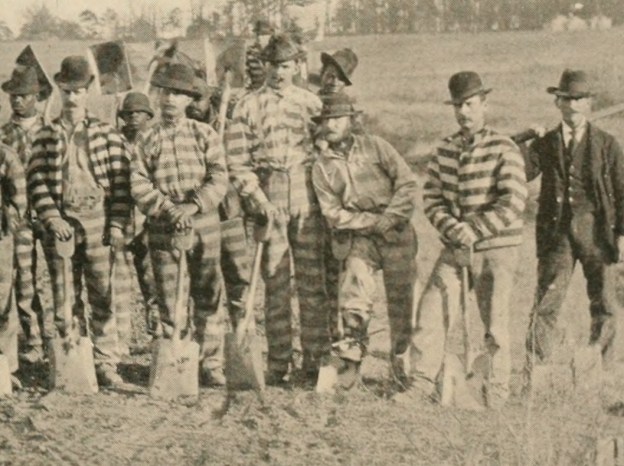
Clady’s bravado in telling the judge he’d rather work on the roads may have been reduced quite a bit by the reality of working on a chain gang.  Chain gangs were the low-cost solution to road building and maintenance until the 1950’s.  Just like in the movies, the men were dressed in black and white striped uniforms and had iron shackles on their ankles joined by a chain short enough to prevent them from running.  They were housed in temporary camps located near their work site, in all weathers, guarded by men with shotguns, and flogged for misbehavior.  They worked with picks and shovels, doing hard labor that is now done by machines.

Clady’s change in attitude was revealed when his name appeared in the newspaper again, this time in a list of thirty-three white men who had escaped the chain gang over a ten-year period.

Life Afterward

The family moved to Mt. Airy soon afterward. In 1930, Lindsay Johnson was no longer working and his three youngest sons were all working in a furniture factory, Clady, as a sprayer.  Lindsay died in 1931 at age 70 and Martha died in 1933. 

By the 1940 census, Clady was living with his youngest sister, Mary, in Washington, D. C.  He was unemployed and unable to work.  His brothers Elijah and John, also living in Mary’s household, both registered for the WWII draft.  Clady apparently never registered, perhaps because of his health, and he died in 1941 of respiratory illnesses.

Sources:  

The Western Sentinel (Winston-Salem, N.C.) Apr 23, 1921, p. 17.  “Clady Johnson Sent to Roads for Month.”

“Winston-Salem Journal,  Dec. 15, 1922, p. 4. “Reward Offered for Runaways,”

Journal Article, “Wage Rates and Hours of Labor in North Carolina Industry,” H. M. Douty; Southern Economic Journal, Vol. 3, No. 2 (Oct., 1936), pp. 175-188.

Federal Reserve Bank of St. Louis: FRASER Newsletter, July 1930, Volume 31, Number 1, Date: July 1930. https://fraser.stlouisfed.org/title/monthly-labor-review-6130/july-1930-608191?page=176

https://www.myamortizationchart.com/inflation-calculator/], accessed 10 July 2025.

 U. S. Bureau of Labor Statistics/Data Tools/Charts and Applications/Inflation Calculator; https://www.bls.gov/data/inflation_calculator.htm, accessed 4 June 2025.

Handbook of labor statistics / U.S. Department of Labor, Bureau of Labor Statistics 1936,  Accessed online on 4 June 2025, at https://babel.hathitrust.org/

1910 U.S. Census, Quaker Gap, Stokes County, N. C.; NARA Microfilm # T624-1128; Enumeration District 182, p. 2B.

 1920 U.S. Census, Winston Township, Forsyth County, N. C.; E. D. 90, pp.  8A-8B.

Winston-Salem, N. C., City Directory, 1921, p. 279; Ancestry.com. U.S. City Directories, 1821-1989, database on-line.

Ernest H. Miller, Miller’s Mount Airy, N. C. City Directory, Asheville NC:  Southern Directory Co., 1928-1929, pp. 170-171.

1930 U.S. Census,  Mt. Airy township, 2nd Ward, Surry County, N. C., ED 86-12,  “Lindsay J. Johnson” family, p. 3B.

1940  U. S. Census, Washington, D. C., Block 15, E. D. 27B, p. 61B; April 9, 1940; accessed on ancestry.com.

Certificate of Death of Clady Johnson, March 7, 1941, District of Columbia, Health Dept., Bureau of Vital Statistics.

A Minister Among Friends

Jesse Allen Johnson, (1838-1920) was the son of Henderson Johnson and Amelia Norman. He was born in the Westfield District of Surry County, N. C., where he lived for several decades. His grandfather, Wright Johnson, was a well-known “local preacher” and deacon of the early Methodist denomination.

Jesse A. Johnson was married in 1859 to Elizabeth Gray. Only two of their children survived the Civil War era. Elizabeth died in 1876. Jesse married again, to a widow from Davidson County, Triphenia Everhart. They continued to live in Westfield.

Around 1890, the name Jesse A. Johnson began to appear in the Meeting Minutes of the Society of Friends (commonly known as Quakers.) A record of that year included “A Minute from White Plains Meeting of Ministry and Oversight asking that Jesse A. Johnson be recorded as a minister among Friends…” His name can also be found as a minister in a number of marriage records in Surry County, including the wedding of his half-brother, Charles Johnson, to Lillian Woodall.

The Yadkin Valley News of Oct. 3, 1891 reported that Rev. Allen Johnson was conducting a revival meeting near Westfield, at Jessup’s schoolhouse. Apparently he continued to preach, using schoolhouses as his venue. An article in the Mount Airy News in 1912 reported incidents at the McBride schoolhouse, during a sermon by Rev. Allen Johnson. In the 1910 census, his home was on McBride Road, in the Flat Rock area. His stepson, William Everhart lived nearby, and his daughter, Mary Hemming, lived with her husband near the granite quarry.

Jesse Allen Johnson died in that area in 1920.

Copyright 27 August 2020 by Glenda Alexander.  All rights reserved.

(News article from The Yadkin Valley News, Mt. Airy, N. C., 23 Oct. 1891, p. 3.  Records consulted include census reports, marriage and death records, newspaper articles, and Meeting Minutes of the Society of Friends.)


Wright Johnson, Part 2: Nancy Wilks, His Wife

Nancy Wilks, wife of Wright Johnson, was born about 1784 in North Carolina, calculated from census reports of 1850-1870. Her family name was stated in the death certificate of her daughter Elizabeth. The census indicates that she did not learn to read or write.

Nancy married Wright Johnson about 1802, calculated from the earliest birthdate indicated for her son Henderson Johnson. Nancy was about 18 years old, her husband, about 28.

The records show eight children. Her children’s birth dates were calculated from census, marriage, death, and burial records. The ages of Nancy’s oldest children are hard to pin down, but there appear to be gaps of several years between some of her childbirths, so it is quite possible that she gave birth to other children who didn’t survive.

  1. Henderson was born between 1803-1810.
  2. Wesley, between 1805-1810.
  3. John, between 1810-1820.
  4. Jemimah, about 1814.
  5. James, 1816.
  6. Mary, about 1821.
  7. Nancy, about 1824.
  8. Elizabeth, 1825.

When Wright walked from Westfield to Norfolk for his ordination in 1836, he was about 62 years old, and Nancy was about 54. Seven of their children probably lived in the family home at that time. Henderson and Wesley were married, and records indicate that Henderson may have continued to live with his parents. Over the decades, all the children except John W. are listed in the census near their parents.

Nancy was named in her husband’s will in 1866: “My beloved wife Nancy Johnson for her natural life or widowhood…the remainder of all my estate both real and personal of every description.” Wright died soon after the making of his will.

In the census of 1870, Nancy still lived in the family home in Westfield, age 86. She and her son Henderson both died before the 1880 census. Henderson apparently still lived with her, with his second wife and several young children.

Many of the Johnson family’s death certificates state that they were buried in a Norman family cemetery in Westfield. That cemetery is now abandoned and located on a private farm. Few of the graves in that cemetery have stones with names on them, but those that do are consistent with the individual death certificates. Mount Herman Methodist Church, near the Johnsons’ home place, was apparently their church and has many unmarked graves in its cemetery.

Sources:

Death Certificate of Elizabeth McMillion, Virginia Death Records, 1912-2014, database on-line, Ancestry.com Operations, Inc., 2015. Original data: Va. Deaths, 1912-2014. Va. Department of Health, Richmond, Va.

Will of Wright Johnson, Will Book 5, 1853-1868, Surry County Register of Deeds, Dobson, N. C.

Wright Johnson, Part 1: Preacher Right

Wright Johnson was born ca. 1774. His name first appeared in the Surry County, North Carolina, census in 1820, when he was about 46 years of age, along with what would appear to be a wife, four sons, and three daughters. He first appeared in Surry tax lists in 1813.  He owned land in the northeast corner of Surry County, bordering on Stokes County, North Carolina, and Patrick County, Virginia, in the area of Archie’s/Archer’s Creek.

In the late 1700’s, John Wesley sent missionaries to America to spread his beliefs among the colonists. A man named Francis Asbury came to America around 1771 and traveled and preached throughout the colonies. Asbury later became a bishop of the newly established Methodist Church. Methodism was spread by means of camp meetings and itinerant preachers who took their doctrine into remote settlements. By the middle of the 1800’s the Methodist denomination was the largest Protestant church in America. Their services were known for their exuberant singing, shouting, and preaching.

Wright Johnson was ordained as a Methodist deacon in 1836, when he was in his sixties. The story is told that he walked the entire distance from Surry County to Norfolk, Virginia about 275 miles, for his ordination. He was described in the Virginia Annual Conference Minutes as a local preacher of the Surry circuit, elected to the office of Deacon by Bishop Elijah Hedding and others on February 17. Consider how healthy and strong he must have been to walk that distance in the depth of winter.

A story in the 1894 Yadkin County News, by Bill Whitehead, told how a Methodist preacher named Right Johnson waded through creeks to preach at a home somewhere near Mount Airy, on “The Cold Friday.” There are a number of “Cold Fridays” on record early in the 19th century, when the temperature did not rise above zero and set records all over the East Coast. One exceptionally cold winter was recorded in Tennessee in 1835, when many livestock froze to death and snow drifted deep. This was only about 100 miles from Wright’s home on the border of North Carolina and Virginia.  Whitehead wrote:

“I recollect on the ‘cold Friday’ that Right Johnson waded the creeks and came to our house to preach. The creeks I speak of are those crossed in traveling from Mount Airy to our house. Where can you find in this day any person who would even ride in a fine rig and go to a common log cabin to preach in such weather as the ‘cold Friday’?

“But the old preachers of an early day had many hardships to encounter. I will mention some of their names. Of the Methodist–Thos. Bryant, Wiley Patterson, James Needham, John Hix and Right Johnson, and later on William Rawley and one of the Roberts. Of the Baptists–John Jones and Jonah Cockerham. The Methodists generally, except Rawley and Roberts, were very poor men who did the most of their traveling on foot.”

© Glenda Alexander, All Rights Reserved.

Sources:

William Lee Grissom, History of Methodism in North Carolina: from 1772 to the Present Time, (Nashville, Tenn.: Publishing House of the M. E. Church, South, 1905).

Mary E. King, “I Have a Memory Trace,” in Nikki Giovanni, editor, Grandmothers: Poems, Reminiscences, and Short Stories about the Keepers of Our Traditions, (New York: Henry Holy and Co., 1994) pp. 114-132.

1820 Census of the United States, Population Schedule of North Carolina, Surry County, Capt. Lachrys District, Wright Johnson household, pp. 760-761.

Hand-written records dated “Norfolk 1836,” in the 1800-1840 Virginia Annual Conference Minutes, located in the McGraw-Page Library Special Collections, Randolph-Macon College, Ashland, Va.

Wright Johnson, Deed of Trust, Surry County Register of Deeds, Dobson N.C., Book X, pp. 206-207.

Wright Johnson, Grantor, Wesley Johnson, Grantee, Deed to Land on Archie’s Creek, Surry County Register of Deeds, Dobson N.C., Book 9, pp. 12-13.

Bill Whitehead, “Oldentime Memories,” Vol. 14, #50, The Yadkin Valley News, Mount Airy, N.C., Thursday, July 5, 1894, p. 1.

David Ludlum, “Historical Weather Facts,” http://userpages.chorus.net/wxalan/wxfact/feb.html, accessed Feb. 18, 2006, Aviation Weather Center, Kansas City, Missouri.

24-7 Family History Circle, “The Year Was 1835,” blog hosted by Ancestry.com, Copyright © 1998-2006, MyFamily.com Inc., 17 September 2006, accessed Sept. 11, 2009.

Iris Harvey, Surry County, North Carolina Tax List-1813, (Raleigh, N. C., author, 1991) p. 48.

A Grandmother’s Heroism

Mary Johnson Hemmings died tragically, trying to save a grandchild in a runaway car.

The Mount Airy News of September 1, 1927, reported on page one: “While trying to stop a car from rolling down an embankment with her grandchild in the car, Mrs. J. F. Hemmings dropped dead near the quarry Monday morning. Her son had parked the car near the house and his five year old boy was playing in it when the car was seen to begin rolling down the hill toward the big shed. Mrs. Hemmings managed to reach the car and had taken hold of the rear fender and tried to hold it back, when she suddenly dropped over. Relatives found her unconscious and rushed her to the hospital but she never rallied, and it is thought she died suddenly, either from a weak heart or from a ruptured blood vessel caused by straining to hold the car back.

“The car rolled on down the bank and the child suffered no ill effects, mashing its nose a little as it fell from the seat, and a fender was bruised on the car.”

A photograph made about 1924 of a grand-niece of Mary Hemmings, sitting on a Ford Model “T” touring car of that era. The weight of such a car was about 1200 pounds, and they were made almost entirely of steel.

Mary Frances Johnson was born in 1874 in Surry County, N. C., to Jessie Allen and Elizabeth Gray Johnson. Her mother died in 1876, likely from the same tuberculosis that took her grandmother’s life a few years previous, and also may have taken her grandfather’s life in 1876. In 1881, Mary and her older brother Lindsay were the only surviving children of their parents. Their father remarried in 1877. Records do not show who raised Mary, but she learned to read and write. Lindsay, who was a teenager when their mother died, married about 1880.

Mary was married in 1891, to James Franklin Hemmings of Surry County, son of Washington and Elizabeth Kenner Hemmings. The wedding took place at her father’s home in the Mt. Airy township.

Mary and James lived on the McBride Road near Mt. Airy, where they owned a farm, and raised nine children. They lost one child before the 1900 census. Mary’s father and his wife and his step-son, William Everhart, were their neighbors. Mary’s brother, Lindsay, lived in Mt. Airy with his wife and children and worked in a furniture factory.

Between 1910 and 1920, James Hemmings and at least one of his sons went to work for the North Carolina Granite Corporation, where James was a foreman. Their home apparently was near the quarry. The account of Mary’s death said that the car rolled toward “the big shed,” probably a cutting shed or other work area at the quarry.

Mary was buried in the Midkiff Cemetery on Quaker Road, near her home, the first in a family plot where one of her sons would join her only four years later, and in two more years, her husband.

Copyright 2019, Glenda Alexander. All rights reserved.

Sources:

  1. Estate Settlement Proceedings for Jeremiah Gray, Sept. 8, 1881, Surry County, North Carolina, Estate Records 1771-1943; Ancestry.com; Original data in N. C. Dept. of Archives, Raleigh.
  2. Lorna W. Barrett, Surry County, North Carolina Marriages 1869-1899 (Toast, N. C.: Published by author, 1998.) p. 188.
  3. Census Data: 1880 Census: Westfield, Surry, North Carolina; Roll: T9_983; Enumeration District: 177; p. 12D; 1900 U. S. Census, Mount Airy, Surry County, N. C.; Microfilm Roll: 1219; p. 9B; Enumeration District: 112; 1910 U. S. Census, Mount Airy, Surry County, N. C.; Microfilm Roll: T624_1133; p. 15B; Enumeration District 136; 1920 U. S. Census, Mount Airy, Surry, North Carolina; Roll: T625_1316; pp. 9A-B; Enumeration District: 256.
  4. “Dies While Trying to Save Little Boy,” Mt. Airy News, Mt. Airy, N. C., 1927; “Loses Life to Save Grandson,” Danbury Reporter, Danbury, N. C., 31 Aug. 1927, p. 1. Images on digitalnc.com
  5. Visit to Midkiff Cemetery, Jan. 26, 2019.
  6. “How much does a Ford Model T weigh?, “ The Frontenac Motor Company , Copyright 2016, URL: http://modelt.ca/.