Tag Archives: Mecklenburg County

Stories from the Smith and Maggie Alexander Family:  The Brothers Enlist


The first Confederate Army conscription in April of 1862 called up men ages 18-35.  Smith and his identical twin,  Silas Washington Alexander were age 36.  While Smith remained in the local militia, “Wash” and their two youngest brothers enlisted in Company B, 13th N. C. Infantry Regiment.

Oswald and Ulysses Columbus Alexander, as well as some of their cousins, served as musicians in the company.  The custom was for a band of mostly brass instruments and drums to play during battle, to encourage the troops.  The Alexanders lived in Mecklenburg County, in the Sharon church community, which had a band that performed for special occasions.  The brothers were, most likely, members of that band.

Washington Alexander was elected to be a Second Lieutenant for Company B.  His company fought in a long list of battles, and Washington was wounded at Williamsburg in May of 1862.  Later that year, when the company was reduced by the high number of casualties, Wash would find himself the leading officer of the company.

The second conscription later in 1862 called on older men to serve.  Smith left the Home Guard  in March 1863, for Company F of the 5th Regiment of North Carolina Cavalry, also called the 63rd Regiment of N. C. Troops. His brothers James Wallace, age 38, and William Newton, 35,  enlisted in the same company, and they served together on horseback.

Gettysburg

Company F served in battles that included the famous Battle of Gettysburg on July 1-3, 1863, as part of the Army of Northern Virginia, under General Robert E. Lee. The cavalry’s duty during the battle was mainly in security and communications.

At Gettysburg, the Confederates, numbering about 75,000, fought against the Army of the Potomac, about 85,000 soldiers. It was a decisive and bloody battle in which the Confederates were turned back and retreated toward the flooded Potomac River. Company F, as part of Robertson’s Brigade, protected the flanks of the army as they crossed the river.  Confederate casualties were huge, with almost 4,000 killed and well over 18.000 wounded.  Union casualties were of similar numbers.

About one month later, on August 3, 1863, James Wallace Alexander died in Charlottesville, Virginia of typhoid fever. As many as 80% of soldiers’ deaths during the war were from sickness rather than wounds, as they lived outdoors in all weathers, used water from streams they themselves contaminated, and were constantly exposed to contagious diseases.  

Out of the Frying Pan, Into the Fire

Smith’s name was listed on a hospital register in Richmond in September of 1863, apparently with a gunshot wound. William was wounded in June 1864, hospitalized in Charlotte with typhoid the following November, and returned to duty in January 1865.

Washington resigned his commission as an officer in September of 1862, citing the fact that he was left as the leading officer of Company B, and that he was too ill to fulfill his duties.  Columbus was taken prisoner in the final battle of the war at Appomattox Court House in April 1865, and he later died of disease as a prisoner of war.  Oswald survived the war and returned home, along with Smith and William.  They had lost two brothers, several cousins and friends and suffered injuries that would affect them the rest of their lives. 

On a lighter note:

Cousin Ham the Bad A**: “Get this horse off me or I’ll shoot you.”

Decades after the war, an old soldier named Paul B. Means, a former Colonel in Company F, wrote a story about a private in his company called “Ham,” (Hamilton) Alexander. Ham and his brother, Sydenham, were cousins a few times removed from Smith and his brothers. Ham was involved in heavy action during the Bristoe Campaign, around October 11, 1863. He turned his horse around too quickly and the horse fell, trapping him underneath. The resourceful Ham aimed his rifle at a dismounted Yankee, took him prisoner, and then made his prisoner get the horse off him.7

True story?  You decide.

Sources:

1. Confederate Muster Rolls in the files of the N. C. State Dept. of Archives and History, Raleigh, N. C.

2. Stephen E. Bradley, North Carolina Confederate Militia Officers Roster: As Contained in the Adjunct General’s Officers Roster, (Wilmington, N. C.: Broadfoot Publishing Co., 1992), p. 233; Bradley, North Carolina Confederate Home Guard Examinations 1863-1864, (Keysville, Va.: the author, 1993) pp i, ii.

3. Louis H. Manarin, North Carolina Troops: 1861-1865 A Roster, Vol. 2–Cavalry, (Raleigh: N. C. State Dept. of Archives and History, 1968), pp. 367-414.; Janet B. Hewett, The Roster of Confederate Soldiers 1861-1865, Vol. I (Wilmington, NC, 1995), p. 92.; Confederate Muster Rolls in the files of the N. C.  State Dept of Archives and History, Raleigh, N. C.

4.  “Gettysburg,”  https://www.battlefields.org/learn/civil-war/battles/gettysburg, The American Battlefield Trust, accessed 5 Aug. 2025.

5. Walter Clark, editor, Histories of the Several Regiments and Battalions from North Carolina in the Great War 1861-65, 5 volumes, (Goldsboro, N. C.: published by the State of North Carolina, 1901,) p.577.

© 2025 by Glenda Alexander.  Standard copyright restrictions apply.
Stories from the Smith and Maggie Alexander Family:  Smith Alexander in the Civil War

Stonewall Jackson

Smith’s children passed down several stories about his experiences in the Civil War.   One story was that he was a “private courier” for Stonewall Jackson.1

Smith was an officer in the local militia company in the Sharon Church community of Mecklenburg County, N. C., and was therefore not eligible for the first Confederate army draft.  Key members of the militia were kept as a “Home Guard” for the protection of the community.  When Smith later enlisted, in March of 18632, General Jackson was only one month from his death by gunshot from his own soldiers, and Smith’s regiment didn’t serve under him. However, Jackson’s wife, Anna, was the daughter of Rev. Robert Hall Morrison, a prominent Presbyterian minister in Mecklenburg County and first president of Davidson College.3 Perhaps the courier duty that Smith served was to carry private messages between the general and Mrs. Jackson’s family.

His children said that he had a bad knee from a gunshot wound.  His war records reveal that he spent some time in Winder hospital in Richmond, in September of 1863.4


Freemasons Help Each Other Survive the War

I heard two versions of the most interesting story about Smith’s military service:

The first account supposedly happened either to Smith or one of his brothers.  He was circling a large oak tree, with a single Yankee soldier on the opposite side. When either of them got a chance, he fired at the other, taking cover behind the tree. The Confederate took a hit on the hand, which resulted in the loss of a thumb. Though he must have been in pain and shock, he kept fighting. Probably at this point the battle became, not an effort to kill the enemy, but an effort to survive. As time passed and neither gained the advantage, one of them called out, “If we keep on like this, both of us are going to die. What if I walk off one way and you go off in the other, and we both live?” And so they did.

Smith was not missing a thumb in his later years, so this either was not true or it happened to someone else.

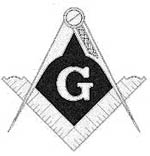
The second version, (and possibly a separate incident) is that Smith, who had a reputation for being able to “thread a needle” with a .36 caliber pistol, gained the advantage over the Union soldier, though both were wounded. The Yankee was on the ground under the muzzle of Smith’s gun. When he was about to fire, the man made a secret sign that revealed he was a Freemason. The bond between Freemasons must have been stronger than the enmity between Confederate and Union soldiers, because Smith helped the man to his feet and let him go. The Yankee walked North and Smith walked South, and they never saw each other again.5

Civil War literature contains a number of similar stories about Freemasons. Soldiers on opposite sides sometimes treated one another with respect on account of their bond as Masons. Men who joined a Freemasons lodge took a pledge never to harm a fellow Mason. A Mason “sign of distress” is spoken of in some stories, and many men wore their Freemason pin on their uniforms.6

Sources:

1.  Interviews with Henry Alexander and Lewis Alexander, grandsons of Smith Alexander, based on their conversations with Oswald, Belle, and Lelia Alexander, by the author in 2001.

2.  Stephen E. Bradley, North Carolina Confederate Militia Officers Roster: As Contained in the Adjunct General’s Officers Roster, (Wilmington NC: Broadfoot Publishing Co., 1992), p. 233; Bradley, North Carolina Confederate Home Guard Examinations 1863-1864, (Keysville, VA: the author, 1993) pp i, ii.; Confederate Muster Rolls in the files of the N.C. State Dept of Archives and History, Raleigh, N.C.

3.  “The Brevard Station Museum,” https://www.brevardstation.com/ Copyright © 1999 by the Stanley, North Carolina Historical Association, (accessed 31 August 2003.)

4. Compiled Service Records of Confederate Soldiers Who Served in Organizations from the State of North Carolina, NARA Publication No. M270, images online at  https://www.fold3.com/image/35359367.

5.  Henry and Lewis Alexander, cited above.

6. Justin Lowe, “Freemasonry and The Civil War: A House Undivided,” n. d., (12 December 2005); Poe, Clarence, editor, True Tales of the South at War: How Soldiers Fought and Families Lived, 1861-1865, (Chapel Hill: The University of North Carolina Press, 1961) p. 8.

Copyright 2025, Glenda Alexander. All rights apply.

From Mecklenburg to Moore: Stories from the Smith and Maggie Alexander Family

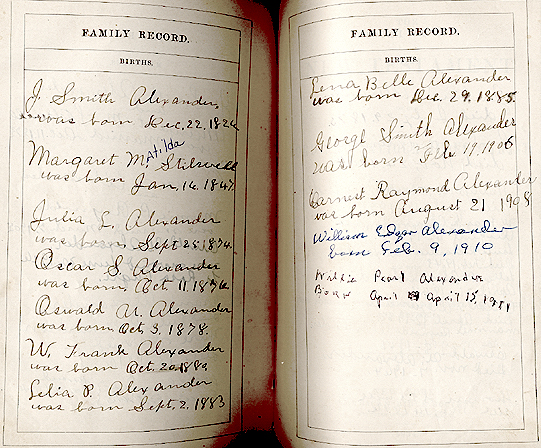
John Smith Alexander was born in Mecklenburg County, N. C. on Dec. 22, 1826, identical twin to Silas Washington Alexander. Their parents were Telemacus and Hannah Smith Alexander. Their father was a blacksmith and wagon-maker, and they grew up in the Sharon Presbyterian Church community.

Telemacus Alexander died in 1842, when the twins were fifteen years old. Their mother died only four years later, leaving ten children. Their oldest brother became head of household and they remained on the family farm. The six sons were all blacksmiths, wagon makers, or wheelwrights. When the Civil War broke out, they and their brothers-in-law all served in the Confederate Army.

Next: Smith Alexander and Brothers in the Civil War

Sources:

Margaret Stilwell Alexander’s Family Bible, (pages pictured above,) owned by Glenda Alexander.

Alexander Notebooks, compiled and researched by Dr. Alvah Stafford, 1951, Volume 1, (Charlotte N. C.: Public Library of Charlotte and Mecklenburg County, 1985) pp. 80-81.

Records of Sharon Presbyterian Church, 1830-1960, Microfilm Reel HF 202, (Presbyterian Historical Society, Montreat, N.C.: 1969.) Vol. 1855-1873, pp. 34-35.

1850 U. S. Census, Mecklenburg County, N. C., NARA Roll: M432:637; p. 79b.

1860 U. S. Census, Eastern Division, Mecklenburg County, N. C., E. D. , p. 11; NARA Microfilm M653_906, accessed online at Ancestry.com.

Illness in the 1800’s

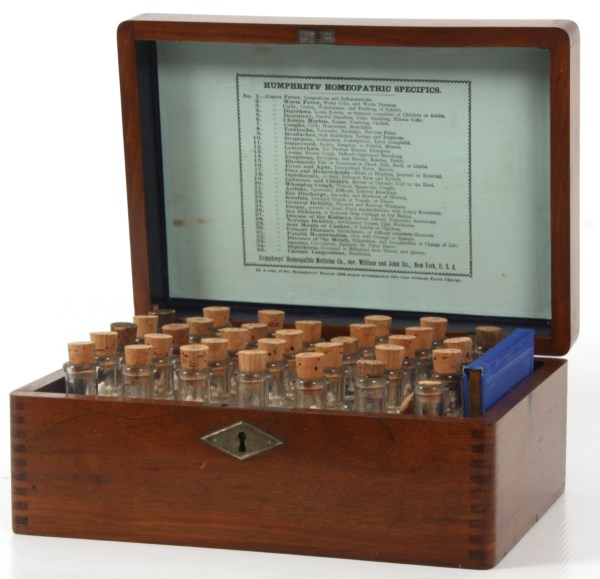
An ad for homeopathic medicines in The Charlotte Observer in 1876 had an extensive list of illnesses and health problems of the time.  Homeopathic medications are extremely diluted plant, mineral, or animal extracts used to treat disease. The object is to produce an immune response in the body by using a very low dose of a substance that will provoke the symptoms of the illness.  In 1876, homeopathic medicine had been around in Europe for nearly a hundred years.  It is still used, but in the U. S. A., it has never been approved by the FDA.

The Mild Power CURES

Humphreys’ Homeopathic Specifics:

Been in general use for twenty years.”

List of Conditions to be cured:

“1.  Fevers, Congestion, and Inflammation

2.  Worms, Worm Fever, Worm Colic

3.  Crying Colic, or teething of Infants

4.  Diarrhea of Children or adults

5.  Dysentery, Griping, Bilious Colic

6.  Cholera-Morbus, Vomiting

7.  Coughs, Colds, Bronchitis

8.  Neuralgia, Toothache, Faceache

9.  Headaches, Sick Headaches, Vertigo

10.  Dyspepsia, Bilious Stomach

11.  Suppressed or Painful Periods

12.  White, too Profuse Periods

13.  Croup, Cough, Difficult Breathing

14.  Salt Rheum, Erysipelas, Eruptions

15.  Rheumatism, Rheumatic Pains

16.  Fever and Ague, Chill Fever, Agues

17.  Piles, blind or bleeding

18.  Ophthalmy, and Sore or Weak Eyes

19.  Catarrh, scute or chronic, Influenza

20.  Whooping-Cough, violent coughs

21.  Asthma, oppressed Breathing

22.  Ear Discharges, impaired Hearing

23.  Scrofula, enlarged glands, Swellings

24.  General Debility, Physical Weakness

25.  Dropsy and scanty Secretions

26.  Sea-sickness, sickness from riding

27.  Kidney Disease, Gravel

28.  Nervous Debility, seminal weakness or involuntary discharges

29.  Sore Mouth, canker

30.  Urinary Weakness, wetting the bed

31.  Painful Periods, with Spasms

32.  Disease of Heart, palpitations, etc.

33.  Epilepsy, Spasms, St. Vitus’ Dance

34.  Diphtheria, ulcerated sore throat

35.  Chronic Congestions and Eruptions”

Each category was treated by a separate homeopathic remedy, which could be bought singly, in small bottles, or in a leather case containing all thirty-five of them. plus a manual, sold by “all druggists” in Charlotte.  This product was distributed from No. 562 Broadway, N. Y.

Source:  Ad in The Charlotte Observer, 18 Aug. 1876, p. 4;  accessed online through newspapers.com.

Glossary:

2.  Worms:  Different kinds of parasites in the digestive system or under the skin.  Roundworms, including pinworms and ascariasis can cause fever.  

3.  Colic:  The symptom of colic is unexplained crying in babies, usually with behavior that shows they are in pain.  Doctors seem to think the most likely causes are teething and digestive pain, but none of them seem to really know.

5.  Dysentery  is bloody diarrhea, caused by bacteria.  Griping is intestinal pain.  Bilious colic is pain caused by gallstones blocking the bile ducts.

6.  Cholera morbus is an old term for cholera, a gastrointestinal infection caused by bacteria, with the major symptom being large amounts of watery diarrhea lasting for days.  There were six cholera pandemics during the 1800’s.  Caused by contaminated water, better sanitation helped to bring it under control.

8.  Neuralgia is a sharp, burning pain along the path of a nerve. caused by damage to the nerve.  it can affect any part of the body. 

9.  Sick headache is accompanied by nausea and includes migraines.

10.  Dyspepsia includes different kinds of indigestion.  Bilious stomach was apparently what we now call acid reflux.

12.  White period is a white discharge before the normal menstrual period, caused by hormonal changes.  It can be normal, or be a symptom of disease or of pregnancy.

13.  Croup is an infection and swelling of the upper airway, which makes it hard to breathe, and it causes a cough that sounds like barking.

14.  Salt rheum was another name for eczema.  Erysipelas is a bacterial skin infection that causes a firy red rash.  An eruption was a rash.

15.  Rheumatism is inflammation in muscles, now usually called rheumatoid arthritis.  It causes chronic pain and soreness.

16.  Ague was malaria or some other illness causing fever and shivering.

17.  Piles are hemorrhoids.

18.  Ophthalmy was inflammation of the eyes.

19.  Catarrh is excessive mucus in the nose or throat, now usually called postnasal drip.

20.  Whooping cough is a very contagious respiratory infection that causes severe coughing.

23.  Scrofula is an infection in the lymph nodes of the neck by the same bacteria as tuberculosis.

25.  Dropsy is edema, or fluid retention in body tissues.

27.  Gravel is kidney stones.

33.  St. Vitus’ Dance  is an auto-immune disease which can be a side effect of rheumatic fever.  It causes uncontrolable jerking movements in the the face, hands and feet.

34.  Diphtheria is a bacterial infection that causes fever and severe sore throat.  It used to cause the death of many children.  Most people in the U. S. Are now vaccinated against diphtheria and whooping cough.

[Defined with help from Mayo Clinic, NIH, and Wikipedia, among others.]

A Slice of Life: 1876

On Friday, August 18, 1876, page four of the Charlotte Observer reported that “The house of Mr. Smith Alexander, in Sharon Township, was entered last Tuesday while the family were absent attending a picnic, and robbed of clothing, meat, flour and everything that could be conveniently carried away.”

Mr. (John) Smith Alexander was 50 years old, and had been married for almost three years to Maggie Stilwell, age 29. They had lost their first child, Julia, the previous year, and in less than two months, Maggie would give birth to their second child, Oscar.

Other articles on the same page of the newspaper give some clues as to what life was like in 1876, as well as what type of picnic they might have been attending. A picnic promoting Temperance, or abstinence from drinking alcohol, was advertised. Temperance was a hot topic in the 1800’s, especially with women whose husbands overindulged and wasted the family’s livelihood and sometimes, became violent when under the influence.

Pills to remedy drinking too much were advertised, as well as a remedy for Dyspepsia, which apparently included all gastrointestinal complaints.  Many ads for patent medicines listed the common illnesses of the time, including tuberculosis, whooping cough, and dysentery.

Several other articles were about picnics and rallies for the political candidates of the period. Zebulon Vance was running for State Governor, again, after serving during the Civil War and spending some time after the war under arrest. The lyrics for a campaign song for Vance were printed on the page, so it would seem that the Observer promoted his candidacy. The Sharon and Steel Creek communities were both mentioned as sites of political rallies.

The articles included many racist remarks.  The Reconstruction period that followed the Civil War lasted until about 1876.  The Democratic Party was the more conservative of the two main political parties.  The Republican party had been the party of President Lincoln.  One article remarked that the Republicans called the newspaper Democratic.

The hard times that followed the war were mentioned. Financial news and grocery ads indicated that bacon, corn, lard, flour, chickens, eggs, butter, honey, and sugar were important items in the diet of the times, and some foods, such as chickens, eggs, and butter, were scarce.  Also mentioned were prices for cheese, rice, meal, grits, molasses, coffee, tea, fish, oats, peas, fruits, and potatoes, as well as wines and liquors.

Ads in the “Ten cent column” cost ten cents per line, minimum twenty-five cents, and included ads for Miss Mary Watson’s school, a gold mine for sale in Huntersville, food, medicine, employment, hotels, and Mason jars.

The robbers were arrested and charged, but the article didn’t mention whether any of the stolen goods were recovered. It seems significant that food was prominent in the list of things taken. For many citizens of North Carolina, the period after the war was a hungry time.

Smith and Maggie would eventually have a total of five children, one of whom was my grandfather, William Franklin Alexander, who was born in 1880. When their children were teenagers, the couple moved to a home on the Deep River in Moore County, N. C., where Smith passed away in 1904, and Maggie, later in 1931.


Sources:  The Charlotte Observer, Charlotte, North Carolina, Friday, August 18, 1876, p. 4, accessed online; “Zebulon Vance,” https://historicsites.nc.gov/all-sites/zebulon-b-vance-birthplace/history/zebulon-vance, accessed 16 Sept. 2024.