
Tag Archives: Moore County

A Millwright in the Family

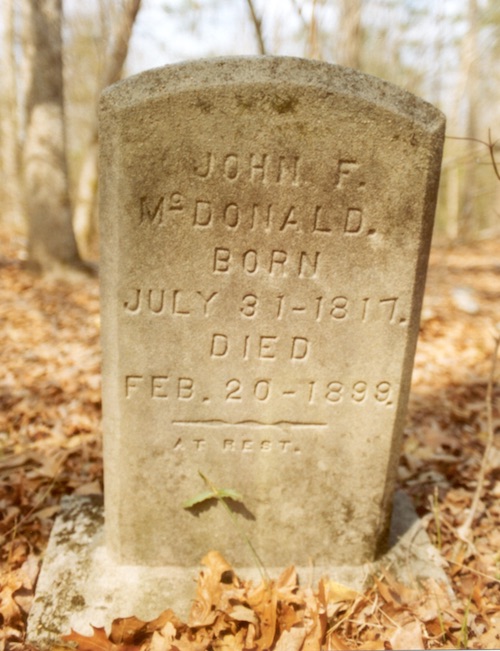
John Finlayson McDonald’s grave stone establishes his birthdate as July 31, 1817. His parents were Angus McDonald and Mary Finlayson of Cumberland County, N. C.

Both Gaelic and English were spoken in the home when John was young, and the members of his family were literate. The census tells us he became a millwright. Millwrights were the engineers of their time, needing skills for working with metal, stone, and wood, and having the knowledge and ability to create the moving parts of the mill. The work required mathematical and engineering knowledge, evidence he had some formal education.

In 1838, when John was age 21, he acquired a farm located between Carthage and Vass. He had 65 acres of land located on both sides of the Lower Little River in Cumberland County, and 100 acres adjoining the Moore County line and his father’s property lines on the river.

In 1848, John F. McDonald bought from Daniel McLeod for $850, 496 acres between Herd and Crain’s Creeks, with enough “land on the North side of Herds Creek as would be necessary for the use of a Mill and overflowing of a pond.” In Branson’s N.C. Business Directories, his name can be found in a list of “Prominent Farmers,” with 500 acres on Crains Creek.

John’s father died before the 1850 census. At that time, his mother lived in the Western Division of Cumberland County on $300 worth of real estate; his three sisters lived with their mother. A millwright named John McDonald, in the neighborhood of 33 years old, lived in the household of a widow with eight children, whose name was Edith Page.

Calculating by age of his oldest son, Angus, John Finlayson McDonald was married to Sarah Strickland around 1857. She was 22 to her husband’s 40 years of age. They had a second son, Malcom Daniel, in 1859, and unfortunately, Sarah died in childbirth. Their infant son was raised by John’s sisters, Sarah, Margaret, and Christian. Angus, their older child, can be found in census records with his father. The family belonged to Cypress Presbyterian Church in Harnett County. John’s mother, Mary Finlayson McDonald, also died sometime between 1850-1860.

John was about 45 years old in 1862, when enlistment for the Confederate Army started. It is likely that he was the John McDonald of Company H of the 6th Regiment, N. C. Senior Reserves, who served in the Civil War until its end in 1865.

About 1866, John married again. Jennet Isabella Patterson was born around 1848 in Cumberland County, and married John, a 49-year-old widower, at about age 18. The Patterson family belonged to Union Presbyterian Church, located between Carthage and Vass, where John became a member.

Their first child, Mary Arabella McDonald, was born in 1867. Their son, Neill Archibald McDonald, was born in 1869. In 1870, their home was in the Greenwood Township of Moore County. John was a millwright whose real estate at that time was valued at $800. Son Angus was age 12 and attended school. The family had neighbors who were farmers, (two who were born in Scotland,) with surnames McDonald, McLean, and Kelly.

Daughter Margaret Anne was born in 1872. Jennet’s father, Neill Patterson, died in 1877.

In 1880, the family, still in Greenwood, included the parents and four children. John was still a millwright, Angus worked as a house carpenter, and Neill was a laborer. John’s son Malcom lived with John’s sister, Christian McDonald, in Cumberland County.

In 1891, Jennet’s mother, Margaret McLean Patterson, died and was buried beside her husband at Union Presbyterian Church.

In 1899, John Finlayson McDonald died and was buried in the Ferguson and McDonald family cemetery near Crain’s Creek. His monument reads: “John F. McDonald; Born July 31–1817. Died February 20–1899. At Rest.” There is a grave to his right marked at head and foot by round field stones, which is the likely resting place of Jennet, who died soon after, in 1901. Their daughter Margaret Ann Hicks and three of her children, as well as their grand-daughter, were later buried in adjacent graves.

Sources:

Alex M. Patterson, Highland Scots Pattersons of North Carolina and Related Families. (Raleigh: Contemporary Lithographers, Inc., 1979), pp. 159-194. Patterson researched the family of John’s second wife, Jennet Isabella Patterson.

1820 U. S. Census; Moore County, N. C., page stamped 298/handwritten 301; NARA Microfilm M33_80.

James Vann Comer, Gone and Almost Forgotten: Crain’s Creek Community, (Sanford: James Vann Comer, 1986), p. 104; census records below.

Son Neill McDonald in 1940 U. S. Census, High Point, Guilford County, N. C., NARA Roll: M-T0627-02921; p. 6B; Enumeration District: 41-90.

1850 U. S. Census, Eastern Division, Cumberland, North Carolina; Roll: 627; Page: 64b; Line Number: 40, Dwelling Number: 1045, Family Number: 1058.

1860 U. S. Census, Moore County, N. C., p. 79; NARA Microfilm M653-906.

Confederate North Carolina Troops: 6th Regiment, North Carolina Senior Reserves, accessed Feb. 1, 2012 at http://www.itd.nps.gov/cwss/regiments.cfm, no date; Weymouth T. Jordan Jr., North Carolina Troops, 1861-1865 : a Roster, Vol. 12, (Raleigh, N.C. : State Dept. of Archives and History, 2004) p. 68.

1870 United States Federal Census, Greenwood Township, Moore County, N. C., p. 34; NARA Microfilm M593-1149.

1880 U. S. Census, Greenwood Township, Moore County, N. C., Enumeration District 133, p. 4D.; NARA Microfilm Roll 973, accessed online at ancestry.com

Visit to cemetery located off County Road 1825, approx. .4 mile from Highway 1, just North of Crains Creek, Moore County, with Lewey Alexander Sr., great-grandson, and William Wilson, great-great grandson, on March 29, 2002. See Findagrave Cemetery ID: 2282051.
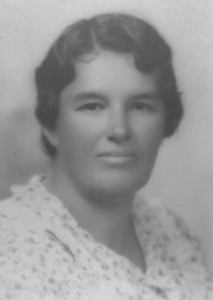
LOULA RICHARDSON ALEXANDER: CHICKEN FARMER, MARKET VENDOR, 1930-1943

In the autumn of 1929, the crash of the American stock market started a period that we now call the Great Depression, which lasted for about a decade and challenged the survival of ordinary Americans.

My parents told many stories about growing up during that time. In my Dad’s family, many of those stories expressed admiration for his mother, Loula Richardson Alexander, and her ceaseless hard work, determination, and inventiveness.

In 1930 Frank and Loula Alexander moved their family of nine children, including one new-born, from a house in the town of Vass, N. C., to a farm nearby, on Union Church Road. Loula went into action. She ordered baby chicks that were delivered by mail in a box with air holes, a hundred at a time. She put paper, sand and boards in a corner of the living room to make a warm home for the chicks while Frank built a brooder house. Eventually she would have five buildings for the purpose of raising chickens, about 500 birds at the peak of her business.

Sometime prior to 1933, the Moore County Home Demonstration Clubs started a farmer’s market in Southern Pines to sell produce to Northern women who had winter homes in Southern Pines and Pinehurst. The market was in a basement, on a side street near the depot in Southern Pines, “on the Pinehurst side.” It was an open room with stepped shelves for merchandise. Each of twenty female vendors had a booth. Loula sold butter, eggs, baked goods, and vegetables. She had a flower garden and sold cut flowers. She also sold canned peaches from the family’s orchard of about 40 peach trees, two varieties.

A curb market commitee established rules about the cleanliness and quality of the produce, and set the prices. Sellers were required to sell at the same prices as local merchants, their one advantage being that they were not required to add sales tax.

The income helped rural women with living expenses, as well as children’s clothing, college tuition, and better health care. One of Loula’s most cherished goals was to send her oldest daughter, Willie, to Duke University.

Total sales for the vendors from Dec. 1, 1932-Nov. 1, 1933 were $3,093.28, worth about $65,833.03 in 2022. If Loula had received an equal 1/20 share of that, $154.66, she received, in 2022 numbers, the equivalent of about $3,277.00 for 12 months’ work. Hopefully, her extra hard work netted her more than that, but even in 1933, the compensation must have seemed a little thin.

Nevertheless, an anonymous woman wrote a letter to the editor of the local newspaper, on the subject of the budget for a county home demonstration agent. She said:

“The curb market alone has brought over three thousand dollars into the Moore county farm homes. It seems to me that we need this kind of work as never before.”

Sellers continued to grow produce into fall and winter to sell at the market. They were motivated to improve their farming practices so as to compete with other sellers. An article about the market in the local newspaper mentioned that “Fresh eggs are at a premium…”

First Loula sold eggs at the market, then she discovered she could sell fryers. When the chickens were 8-12 weeks old, they became frying size, about two to two and a half pounds. At that point, she could identify the sex. The boxes of baby chicks contained about an equal number of males and females. If the pullets (young hens) were good layers she kept them to produce eggs, while other hens became fryers. She would sell 3-4 dozen hens per week at the curb market. She learned to caponize young roosters from the Moore County Agricultural Extension agent, and she sold the capons for baking. They would grow larger than the hens, and she sold a lot of them for Thanksgiving dinners.

Dr. Earl Wayne Hunter, a dentist from south Sanford, near Highway One, owned Dr. Hunter’s Hatchery, another market for Loula, as he bought fertilized eggs. She could tell with a candle if an egg contained a chicken embryo.

Loula’s children were very much involved in her business. Several of them described coming home from school on Friday afternoon and immediately joining their mother in preparing chickens for the market. Loula did the slaughtering herself, and the children helped to remove feathers, etc. Their mother would set out alone very early on Saturday morning with her merchandise and come home later with treats they couldn’t produce on the farm, like Jello.

In spite of Loula’s diligence and obvious contribution to the family income, the 1940 census taker described her occupation, just like many wives of the time, with a blank line and checked that she was “engaged in home housework,” and further indicated that she earned no income. Incredible.

When Loula passed away, age 51, in 1943, World War II was in force. She had two married daughters, two sons in the Army, one son in college—soon to be in the Marine Corps, and three younger children living at home. Sadly, she had lost one son to illness in 1935. Her husband, Frank Alexander, was diagnosed with lung cancer and passed away only a year and a half later.

Copyright 2022 by Glenda Alexander.  All rights reserved.

Sources:

Interviews with Lewey Alexander Sr., Robert L. Alexander, Patsy Alexander Rodgers, and Willie Alexander Carr.

1940 U. S. Census, McNeill’s Township, Moore County, N. C., E. D. 69-13, p. 11A; West Sanford, Lee County, N. C. ED 53-7, sheet 7B.

The Pilot, newspaper, Vass, Aberdeen, & Southern Pines: Friday, Mar. 28, 1930, p. 9; 29 April, 1932, p. 2.; Nov. 17, 1933, Edition 1, pp. 4-5; December 29, 1939, p. 4.

USD Inflation, https://www.usdinflation.com/amount/154/1933, accessed 20 Feb. 2022.