
Category Archives: Medicine

Illness in the 1800’s

An ad for homeopathic medicines in The Charlotte Observer in 1876 had an extensive list of illnesses and health problems of the time.  Homeopathic medications are extremely diluted plant, mineral, or animal extracts used to treat disease. The object is to produce an immune response in the body by using a very low dose of a substance that will provoke the symptoms of the illness.  In 1876, homeopathic medicine had been around in Europe for nearly a hundred years.  It is still used, but in the U. S. A., it has never been approved by the FDA.

The Mild Power CURES

Humphreys’ Homeopathic Specifics:

Been in general use for twenty years.”

List of Conditions to be cured:

“1.  Fevers, Congestion, and Inflammation

2.  Worms, Worm Fever, Worm Colic

3.  Crying Colic, or teething of Infants

4.  Diarrhea of Children or adults

5.  Dysentery, Griping, Bilious Colic

6.  Cholera-Morbus, Vomiting

7.  Coughs, Colds, Bronchitis

8.  Neuralgia, Toothache, Faceache

9.  Headaches, Sick Headaches, Vertigo

10.  Dyspepsia, Bilious Stomach

11.  Suppressed or Painful Periods

12.  White, too Profuse Periods

13.  Croup, Cough, Difficult Breathing

14.  Salt Rheum, Erysipelas, Eruptions

15.  Rheumatism, Rheumatic Pains

16.  Fever and Ague, Chill Fever, Agues

17.  Piles, blind or bleeding

18.  Ophthalmy, and Sore or Weak Eyes

19.  Catarrh, scute or chronic, Influenza

20.  Whooping-Cough, violent coughs

21.  Asthma, oppressed Breathing

22.  Ear Discharges, impaired Hearing

23.  Scrofula, enlarged glands, Swellings

24.  General Debility, Physical Weakness

25.  Dropsy and scanty Secretions

26.  Sea-sickness, sickness from riding

27.  Kidney Disease, Gravel

28.  Nervous Debility, seminal weakness or involuntary discharges

29.  Sore Mouth, canker

30.  Urinary Weakness, wetting the bed

31.  Painful Periods, with Spasms

32.  Disease of Heart, palpitations, etc.

33.  Epilepsy, Spasms, St. Vitus’ Dance

34.  Diphtheria, ulcerated sore throat

35.  Chronic Congestions and Eruptions”

Each category was treated by a separate homeopathic remedy, which could be bought singly, in small bottles, or in a leather case containing all thirty-five of them. plus a manual, sold by “all druggists” in Charlotte.  This product was distributed from No. 562 Broadway, N. Y.

Source:  Ad in The Charlotte Observer, 18 Aug. 1876, p. 4;  accessed online through newspapers.com.

Glossary:

2.  Worms:  Different kinds of parasites in the digestive system or under the skin.  Roundworms, including pinworms and ascariasis can cause fever.  

3.  Colic:  The symptom of colic is unexplained crying in babies, usually with behavior that shows they are in pain.  Doctors seem to think the most likely causes are teething and digestive pain, but none of them seem to really know.

5.  Dysentery  is bloody diarrhea, caused by bacteria.  Griping is intestinal pain.  Bilious colic is pain caused by gallstones blocking the bile ducts.

6.  Cholera morbus is an old term for cholera, a gastrointestinal infection caused by bacteria, with the major symptom being large amounts of watery diarrhea lasting for days.  There were six cholera pandemics during the 1800’s.  Caused by contaminated water, better sanitation helped to bring it under control.

8.  Neuralgia is a sharp, burning pain along the path of a nerve. caused by damage to the nerve.  it can affect any part of the body. 

9.  Sick headache is accompanied by nausea and includes migraines.

10.  Dyspepsia includes different kinds of indigestion.  Bilious stomach was apparently what we now call acid reflux.

12.  White period is a white discharge before the normal menstrual period, caused by hormonal changes.  It can be normal, or be a symptom of disease or of pregnancy.

13.  Croup is an infection and swelling of the upper airway, which makes it hard to breathe, and it causes a cough that sounds like barking.

14.  Salt rheum was another name for eczema.  Erysipelas is a bacterial skin infection that causes a firy red rash.  An eruption was a rash.

15.  Rheumatism is inflammation in muscles, now usually called rheumatoid arthritis.  It causes chronic pain and soreness.

16.  Ague was malaria or some other illness causing fever and shivering.

17.  Piles are hemorrhoids.

18.  Ophthalmy was inflammation of the eyes.

19.  Catarrh is excessive mucus in the nose or throat, now usually called postnasal drip.

20.  Whooping cough is a very contagious respiratory infection that causes severe coughing.

23.  Scrofula is an infection in the lymph nodes of the neck by the same bacteria as tuberculosis.

25.  Dropsy is edema, or fluid retention in body tissues.

27.  Gravel is kidney stones.

33.  St. Vitus’ Dance  is an auto-immune disease which can be a side effect of rheumatic fever.  It causes uncontrolable jerking movements in the the face, hands and feet.

34.  Diphtheria is a bacterial infection that causes fever and severe sore throat.  It used to cause the death of many children.  Most people in the U. S. Are now vaccinated against diphtheria and whooping cough.

[Defined with help from Mayo Clinic, NIH, and Wikipedia, among others.]
Victim of a Pandemic


OLYMPUS DIGITAL CAMERA

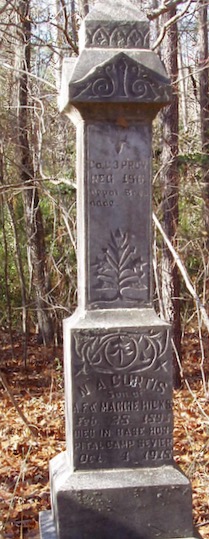
Grave stone of Neill Abner Curtis Hicks, 1897-1918

There is an old Scottish cemetery in the Sandhills of North Carolina, where the oldest grave is dated 1796. Many people buried there were from the Western Isles of Scotland, including Jura and Skye. They spoke Gaelic.  Most of the graves have the names Ferguson and McDonald on them. The last monument was a tribute to a soldier who fell in World War I, not from an enemy bullet, but from a virus, during the 1918 Influenza Pandemic.

My aunt, Willie Alexander Carr, told me of walking to the cemetery with her mother, Loula Richardson Alexander, when Willie was seven years old. They went down a lane and through the woods near the Alexanders’ farm, balancing on a log to cross the creek. They were visiting the grave of Loula’s first cousin, Curtis Hicks.

The Hicks family lived in the township of Greenwood, in Moore County, North Carolina. Abner Hicks and Margaret McDonald married in 1890, and by 1902, they had five children. Then they lost their sixth child as an infant, and two years later, after the birth of twins, Margaret died. Her babies, a boy and a girl, died soon after. Their graves were all placed beside Margaret’s parents in the old cemetery.

In 1911, Abner remarried, to Flora Ann Yow, a neighbor. My father remembered her as “Aunt Flora Ann,” beloved by the family for her kindness to her step-children.

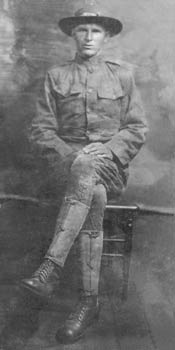
The fourth child of Abner and Margaret, Curtis, was twenty-one when young men were drafted for the Great War. His draft card described him as dark haired and blue eyed. He worked for a local farmer, Angus Cameron, who owned a saw mill. Curtis registered in June of 1918 and left his home for Fort Jackson in August.

Curtis was assigned to Camp Sevier, built in 1917 near Greenville, S. C., to train soldiers for the war. By the Armistice in November 1918, 80,000 soldiers had passed through the large camp. In September of 1918, the first influenza case appeared in the camp hospital, and it opened a floodgate.

The epidemic developed so rapidly that facilities and staff were expanded and taxed to the limit. When the hospital filled up, the Red Cross and Y. M. C. A. buildings, the schoolhouse, a theater, mess halls, and tents became hospital wards. Medical officers were joined by civilian, professional, and practical nurses in tending to a total of 6,000 patients.

Personnel used many precautions, isolating patients with hanging sheets and screens. Doctors, nurses, and attendants wore masks and gowns. Patients with pneumonia were placed in separate wards. Disposable cups and plates were used and burned afterward.

Curtis Hicks was one of the unfortunate soldiers who developed pneumonia, which caused his lungs to hemorrhage and quickly caused his death. Three hundred and forty soldiers died, a death rate over 5% in the camp. He died on October 4, only a few months after his induction into the Army. By November 11, the epidemic, as well as the war, was effectively over.

Curtis was buried near his mother and his grandfather, John Finlayson McDonald. Willie and Loula visited the grave when fresh soil was still mounded over it. Woods now cover the acre of old family graves, and real estate development has slowly surrounded it.

Copyright 2020 by Glenda Alexander. All rights reserved.

Sources:

wwI_soldier

Willie D. Richardson, cousin of Curtis Hicks, WWI

1900 U. S. Census, McNeill’s Tshp., Moore County, N. C., p. 169; NARA Microfilm T623-1207; 1910 U. S. Census, McNeill’s Tshp., Moore County, N. C., p. 193; NARA Microfilm T624-1119; 1920 U. S. Census, Vass, Moore County, N. C., E. D. 92, p. 21B; NARA Microfilm T625-1300; accessed on Ancestry.com.

North Carolina, Marriage Records, 1741-2011 [database on-line]. Provo, UT, USA: Ancestry.com Operations, Inc., 2015. Original data: North Carolina County Registers of Deeds. Microfilm. Record Group 048. North Carolina State Archives, Raleigh, NC.

U.S., World War I Draft Registration Cards, 1917-1918 [database on-line]. Provo, UT, USA: Ancestry.com Operations Inc, 2005.;

South Carolina Death Records, 1821-1955 [database on-line]. Provo, UT, USA: Ancestry.com Operations Inc, 2008. Original data: South Carolina. South Carolina death records. Columbia, SC, USA: South Carolina Department of Archives and History.

Influenza Outbreak of 1918-1919, by Steve Case, revised by Lisa Gregory, 2010, NC Government and Heritage Library, NCPedia.com. Accessed 7 March 2020.

U.S., Lists of Men Ordered to Report to Local Board for Military Duty, 1917–1918 [database on-line]. Original data: War Department, Office of the Provost Marshal General, Selective Service System, 1917– 07/15/1919. National Archives at College Park. College Park, Maryland.

Office of Medical History: Office of the Surgeon General, “Extracts from Reports Relative to Influenza, Pneumonia, and Respiratory Diseases,” April 4, 2003, http://history.amedd.army.mil/booksdocs/wwi/1918flu/ARSG1919/ARSG1919Extractsflu.htm#U1. (continued)%20CAMP%20SEVIER%20BASE%20HOSPITAL%20REPORT, accessed March 9, 2020.

Grave monument in McDonald-Ferguson family cemetery, off County Road 1825, approx. .4 mile from Highway 1, just north of Crains Creek, Moore County. Visit to cemetery and photographs taken March 29, 2002.

Interviews with Willie Alexander Carr and Lewey G. Alexander, Sr., by the author, April 1, 2002.

Tuberculosis

September 25th, this week, was “World Lung Day.”The World Health Organization, concerned about a world-wide epidemic of tuberculosis,  got a hearing this week at the United Nations to ask for funding to fight the leading infectious killer of human beings in the world today.

The United States gained control over the disease during the mid-20th century, after the introduction of antibiotics and x-rays. I remember the mobile x-ray unit that used to visit the county seat at least once a year. My mother and other people with family members who had the disease were required to get a yearly x-ray so that the illness could be promptly diagnosed and treated. My brothers and I would wait in the car on the courthouse square while she stood in line.

Apparently this was a common experience all across the U. S. The American Lung Association raised money from the sale of Christmas and Easter Seals, stamp-like stickers you could put on your cards and letters, advertising the organization’s efforts against “lung diseases, air pollution and smoking.”

My mother’s half-sister, Reba Oakley, and Reba’s mother and grandfather, from Surry County, N. C., all died of tuberculosis. In 1912, when Reba was born, T. B. was causing more deaths than heart disease or cancer, and The American Lung Association was less than a decade old. Reba’s mother died of the disease only 3 years later.

Reba’s grandfather, William Tyson Snow, had already died in 1906, of “consumption,” as it was called then. The family apparently believed that the infection was latent in Reba’s lungs for decades. She became ill as an adult and was treated at a state sanitarium for several years, before succumbing to the debilitating effects of T. B. at age 34.

A latent infection from T. B. is now said to be very rare. It is possible that Reba was infected as an adult. However, because of her infection, her family were all required to be x-rayed yearly for several years. Fortunately, they all remained healthy.

Poverty contributes to the prevalence of the disease in Africa and Asia today. However, it’s easy to forget that only a century ago, many of our own citizens were working on subsistence farms and spending long days in textile and other factories, where their exposure to lint and other air pollutants made them sick. As unemployment and homelessness grow in our population, so do diseases we often consider misfortunes of the past.

Copyright 2018 by Glenda Alexander.  All Rights Reserved.

More about Reba Oakley and family:

http://home.earthlink.net/~glendaalex/reba.htm

Sources consulted online:

http://www.lung.org

Esther Johnson of the Surry County Genealogical Association commented, concerning the Mt. Airy Granite Quarry: “That was one of the things that happened to people who worked in our Quarry here in Mt. Airy. Everyone at school had to take a test for TB.”