Category Archives: Richardson

Veteran’s Day Reflections

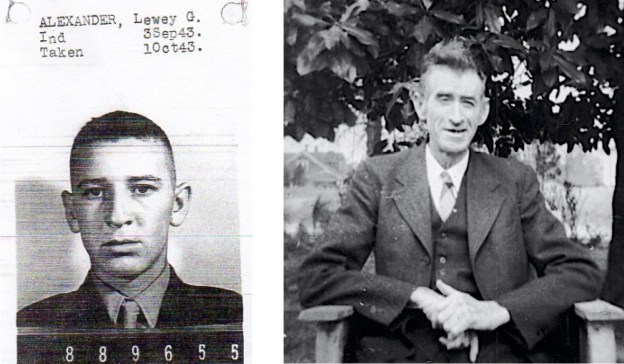
During World War II, my father (pictured on his military i. d., above at left) and three of his brothers and two brothers-in-law all served in the armed forces. All survived the war. However, the family lost both parents during war-time. My grandmother, Loula Alexander, died in February of 1943, and then my grandfather, Frank Alexander, (pictured at right above, 1945) was diagnosed with lung cancer and died in 1945.

A document filed with my father’s military records reveals a lot about the family’s situation.

The Servicemen’s Dependents Allowance Act of 1942 provided allowances for the support of the families of soldiers. Class B covered parents and siblings who were dependent on the soldier. The allowance for one parent was $15 per month, plus an additional $5 for each sibling, not exceeding $50 per month. The deduction from the soldier’s pay was $22 per month.

A Dependency Affidavit filed by Frank Alexander January 3, 1945, stated “Due to ill health I am confined to bed and unable to support myself and children.” He was age 64 and lived in Vass, N. C. His wife had died in February of 1943. The affidavit certified that he was dependent on a serviceman for more than half of his income, and asked for a Class B-1 family allowance.

Frank had two dependent children living at home, Max and Patsy Lou, who were both in school. Frank had $140 in the bank and had received $200 in “allotments” from his son, PFC Lewey Alexander, since September of the previous year. Lewey (called Tuppin by the family,) was age 20 and unmarried. Frank’s son Jack was age 30, married and serving in the Army, and son Robert, age 17 and single, was in the Merchant Marine.

At that time, Frank and his children lived in a house that he owned in the town of Vass. The house and lot were worth $1000. He had an additional 82 acres of land, also worth $1000. From the estate of his wife he had inherited $2300 worth of stock in the Carolina Power and Light Company. He was debt-free.

In 1942 and 1943, Lewey had worked on the farm, helping to raise crops during his vacation from college (Lees-McRae.) After enlistment in the U. S. Marines in 1944, he contributed $50 per month to his family’s income. Frank had become unable to work and only Lewey was able to contribute to the family income.

Additional notes:

Frank died eight months later, on August 4 of 1945. He had eight surviving children, including two older, married daughters, and a son, John Alexander, who survived the attack on Pearl Harbor in 1941 and received a medical discharge in 1942. John was married, and his first child was born a week after the affidavit was signed.

Upon requesting my father’s military records from World War II, I learned that a fire at the National Personnel Records Center in 1973 destroyed most of them. You can request copies of documents online through the E Vet Records application, but the local V. A. helped me apply for the few records that are left from other sources.

Sources:

“Lewey Glenn Alexander Dependency Affidavit,” Jan. 3, 1945; NARA.

https://www.ssa.gov/policy/docs/ssb/v6n7/v6n7p21.pdf, acceded 9 Nov. 2024; Administration of the Servicemen’s Dependents Allowance Act; https://maint.loc.gov/law/help/statutes-at-large/77th-congress/session-2/c77s2ch443.pdf, publication on Library of Congress website.

“The 1973 Fire, National Personnel Records Center,” https://www.archives.gov/personnel-records-center/fire-1973, accessed 9 Nov. 2024.

Family Records in the possession of the author.
A Millwright in the Family

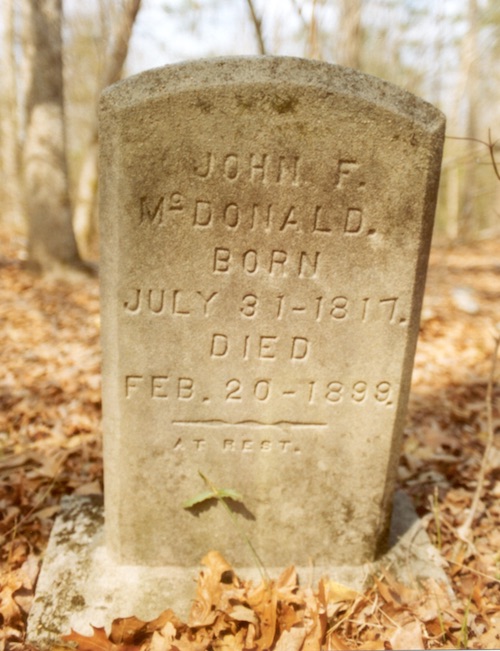
John Finlayson McDonald’s grave stone establishes his birthdate as July 31, 1817. His parents were Angus McDonald and Mary Finlayson of Cumberland County, N. C.

Both Gaelic and English were spoken in the home when John was young, and the members of his family were literate. The census tells us he became a millwright. Millwrights were the engineers of their time, needing skills for working with metal, stone, and wood, and having the knowledge and ability to create the moving parts of the mill. The work required mathematical and engineering knowledge, evidence he had some formal education.

In 1838, when John was age 21, he acquired a farm located between Carthage and Vass. He had 65 acres of land located on both sides of the Lower Little River in Cumberland County, and 100 acres adjoining the Moore County line and his father’s property lines on the river.

In 1848, John F. McDonald bought from Daniel McLeod for $850, 496 acres between Herd and Crain’s Creeks, with enough “land on the North side of Herds Creek as would be necessary for the use of a Mill and overflowing of a pond.” In Branson’s N.C. Business Directories, his name can be found in a list of “Prominent Farmers,” with 500 acres on Crains Creek.

John’s father died before the 1850 census. At that time, his mother lived in the Western Division of Cumberland County on $300 worth of real estate; his three sisters lived with their mother. A millwright named John McDonald, in the neighborhood of 33 years old, lived in the household of a widow with eight children, whose name was Edith Page.

Calculating by age of his oldest son, Angus, John Finlayson McDonald was married to Sarah Strickland around 1857. She was 22 to her husband’s 40 years of age. They had a second son, Malcom Daniel, in 1859, and unfortunately, Sarah died in childbirth. Their infant son was raised by John’s sisters, Sarah, Margaret, and Christian. Angus, their older child, can be found in census records with his father. The family belonged to Cypress Presbyterian Church in Harnett County. John’s mother, Mary Finlayson McDonald, also died sometime between 1850-1860.

John was about 45 years old in 1862, when enlistment for the Confederate Army started. It is likely that he was the John McDonald of Company H of the 6th Regiment, N. C. Senior Reserves, who served in the Civil War until its end in 1865.

About 1866, John married again. Jennet Isabella Patterson was born around 1848 in Cumberland County, and married John, a 49-year-old widower, at about age 18. The Patterson family belonged to Union Presbyterian Church, located between Carthage and Vass, where John became a member.

Their first child, Mary Arabella McDonald, was born in 1867. Their son, Neill Archibald McDonald, was born in 1869. In 1870, their home was in the Greenwood Township of Moore County. John was a millwright whose real estate at that time was valued at $800. Son Angus was age 12 and attended school. The family had neighbors who were farmers, (two who were born in Scotland,) with surnames McDonald, McLean, and Kelly.

Daughter Margaret Anne was born in 1872. Jennet’s father, Neill Patterson, died in 1877.

In 1880, the family, still in Greenwood, included the parents and four children. John was still a millwright, Angus worked as a house carpenter, and Neill was a laborer. John’s son Malcom lived with John’s sister, Christian McDonald, in Cumberland County.

In 1891, Jennet’s mother, Margaret McLean Patterson, died and was buried beside her husband at Union Presbyterian Church.

In 1899, John Finlayson McDonald died and was buried in the Ferguson and McDonald family cemetery near Crain’s Creek. His monument reads: “John F. McDonald; Born July 31–1817. Died February 20–1899. At Rest.” There is a grave to his right marked at head and foot by round field stones, which is the likely resting place of Jennet, who died soon after, in 1901. Their daughter Margaret Ann Hicks and three of her children, as well as their grand-daughter, were later buried in adjacent graves.

Sources:

Alex M. Patterson, Highland Scots Pattersons of North Carolina and Related Families. (Raleigh: Contemporary Lithographers, Inc., 1979), pp. 159-194. Patterson researched the family of John’s second wife, Jennet Isabella Patterson.

1820 U. S. Census; Moore County, N. C., page stamped 298/handwritten 301; NARA Microfilm M33_80.

James Vann Comer, Gone and Almost Forgotten: Crain’s Creek Community, (Sanford: James Vann Comer, 1986), p. 104; census records below.

Son Neill McDonald in 1940 U. S. Census, High Point, Guilford County, N. C., NARA Roll: M-T0627-02921; p. 6B; Enumeration District: 41-90.

1850 U. S. Census, Eastern Division, Cumberland, North Carolina; Roll: 627; Page: 64b; Line Number: 40, Dwelling Number: 1045, Family Number: 1058.

1860 U. S. Census, Moore County, N. C., p. 79; NARA Microfilm M653-906.

Confederate North Carolina Troops: 6th Regiment, North Carolina Senior Reserves, accessed Feb. 1, 2012 at http://www.itd.nps.gov/cwss/regiments.cfm, no date; Weymouth T. Jordan Jr., North Carolina Troops, 1861-1865 : a Roster, Vol. 12, (Raleigh, N.C. : State Dept. of Archives and History, 2004) p. 68.

1870 United States Federal Census, Greenwood Township, Moore County, N. C., p. 34; NARA Microfilm M593-1149.

1880 U. S. Census, Greenwood Township, Moore County, N. C., Enumeration District 133, p. 4D.; NARA Microfilm Roll 973, accessed online at ancestry.com

Visit to cemetery located off County Road 1825, approx. .4 mile from Highway 1, just North of Crains Creek, Moore County, with Lewey Alexander Sr., great-grandson, and William Wilson, great-great grandson, on March 29, 2002. See Findagrave Cemetery ID: 2282051.

LOULA RICHARDSON ALEXANDER: CHICKEN FARMER, MARKET VENDOR, 1930-1943

In the autumn of 1929, the crash of the American stock market started a period that we now call the Great Depression, which lasted for about a decade and challenged the survival of ordinary Americans.

My parents told many stories about growing up during that time. In my Dad’s family, many of those stories expressed admiration for his mother, Loula Richardson Alexander, and her ceaseless hard work, determination, and inventiveness.

In 1930 Frank and Loula Alexander moved their family of nine children, including one new-born, from a house in the town of Vass, N. C., to a farm nearby, on Union Church Road. Loula went into action. She ordered baby chicks that were delivered by mail in a box with air holes, a hundred at a time. She put paper, sand and boards in a corner of the living room to make a warm home for the chicks while Frank built a brooder house. Eventually she would have five buildings for the purpose of raising chickens, about 500 birds at the peak of her business.

Sometime prior to 1933, the Moore County Home Demonstration Clubs started a farmer’s market in Southern Pines to sell produce to Northern women who had winter homes in Southern Pines and Pinehurst. The market was in a basement, on a side street near the depot in Southern Pines, “on the Pinehurst side.” It was an open room with stepped shelves for merchandise. Each of twenty female vendors had a booth. Loula sold butter, eggs, baked goods, and vegetables. She had a flower garden and sold cut flowers. She also sold canned peaches from the family’s orchard of about 40 peach trees, two varieties.

A curb market commitee established rules about the cleanliness and quality of the produce, and set the prices. Sellers were required to sell at the same prices as local merchants, their one advantage being that they were not required to add sales tax.

The income helped rural women with living expenses, as well as children’s clothing, college tuition, and better health care. One of Loula’s most cherished goals was to send her oldest daughter, Willie, to Duke University.

Total sales for the vendors from Dec. 1, 1932-Nov. 1, 1933 were $3,093.28, worth about $65,833.03 in 2022. If Loula had received an equal 1/20 share of that, $154.66, she received, in 2022 numbers, the equivalent of about $3,277.00 for 12 months’ work. Hopefully, her extra hard work netted her more than that, but even in 1933, the compensation must have seemed a little thin.

Nevertheless, an anonymous woman wrote a letter to the editor of the local newspaper, on the subject of the budget for a county home demonstration agent. She said:

“The curb market alone has brought over three thousand dollars into the Moore county farm homes. It seems to me that we need this kind of work as never before.”

Sellers continued to grow produce into fall and winter to sell at the market. They were motivated to improve their farming practices so as to compete with other sellers. An article about the market in the local newspaper mentioned that “Fresh eggs are at a premium…”

First Loula sold eggs at the market, then she discovered she could sell fryers. When the chickens were 8-12 weeks old, they became frying size, about two to two and a half pounds. At that point, she could identify the sex. The boxes of baby chicks contained about an equal number of males and females. If the pullets (young hens) were good layers she kept them to produce eggs, while other hens became fryers. She would sell 3-4 dozen hens per week at the curb market. She learned to caponize young roosters from the Moore County Agricultural Extension agent, and she sold the capons for baking. They would grow larger than the hens, and she sold a lot of them for Thanksgiving dinners.

Dr. Earl Wayne Hunter, a dentist from south Sanford, near Highway One, owned Dr. Hunter’s Hatchery, another market for Loula, as he bought fertilized eggs. She could tell with a candle if an egg contained a chicken embryo.

Loula’s children were very much involved in her business. Several of them described coming home from school on Friday afternoon and immediately joining their mother in preparing chickens for the market. Loula did the slaughtering herself, and the children helped to remove feathers, etc. Their mother would set out alone very early on Saturday morning with her merchandise and come home later with treats they couldn’t produce on the farm, like Jello.

In spite of Loula’s diligence and obvious contribution to the family income, the 1940 census taker described her occupation, just like many wives of the time, with a blank line and checked that she was “engaged in home housework,” and further indicated that she earned no income. Incredible.

When Loula passed away, age 51, in 1943, World War II was in force. She had two married daughters, two sons in the Army, one son in college—soon to be in the Marine Corps, and three younger children living at home. Sadly, she had lost one son to illness in 1935. Her husband, Frank Alexander, was diagnosed with lung cancer and passed away only a year and a half later.

Copyright 2022 by Glenda Alexander.  All rights reserved.

Sources:

Interviews with Lewey Alexander Sr., Robert L. Alexander, Patsy Alexander Rodgers, and Willie Alexander Carr.

1940 U. S. Census, McNeill’s Township, Moore County, N. C., E. D. 69-13, p. 11A; West Sanford, Lee County, N. C. ED 53-7, sheet 7B.

The Pilot, newspaper, Vass, Aberdeen, & Southern Pines: Friday, Mar. 28, 1930, p. 9; 29 April, 1932, p. 2.; Nov. 17, 1933, Edition 1, pp. 4-5; December 29, 1939, p. 4.

USD Inflation, https://www.usdinflation.com/amount/154/1933, accessed 20 Feb. 2022.

A Mill Family’s Losses in 1918

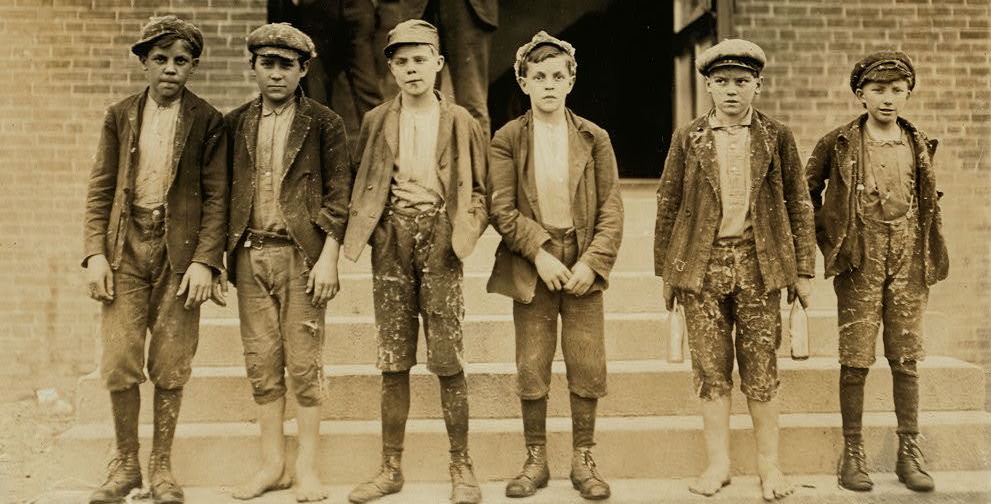
Boy workers in a N. C. cotton mill. The white specks on their clothing are cotton lint.

I wrote earlier, in “Victim of a Pandemic,” about a World War I soldier who lost his life to the influenza pandemic of 1918. His mother, Margaret McDonald Hicks, had a brother, Neill Archibald McDonald, who lost three children and a daughter-in-law to that pandemic.

Margaret and Neill grew up in the Sandhills region of North Carolina. Their grandfather, Angus McDonald, came from the Western Isles of Scotland to North Carolina near the end of the 1700’s. He came to this country speaking Scots Gaelic, the language his family continued to use at home through his grandchildren’s generation. Neill and his siblings spoke fluent Gaelic, and the language died out with their generation in the first half of the twentieth century.

As a young man, Neill left his home in the Sandhills and traveled to New Orleans, where, in 1897, he met and married Marie Gottschalk, whose family came from Germany. Neill and Marie moved back to his home in Moore County, N. C., and around 1912, they moved on to High Point, N. C., a growing mill town. There, Neill found work at the brand new Highland Cotton Mills and a home in the mill village.

Neill worked at Highland until his retirement in the 1930’s. Marie gave birth to at least thirteen children, one of whom died as an infant. The other twelve children were all Highland Cotton Mill employees, as were their spouses and children.

Early cotton mills are notorious for having employed children, for very low wages. The census of 1920 and 1930 reports children in the family as young as age 15 working in the mill. However, the children probably went to work at much earlier ages.

During the pandemic of 1918, three of Neill and Marie’s children died of influenza. The youngest was Wilbert, age 9, described on his death certificate as a mill worker, as were his brothers John, age 16, and Frederick, 18. Annie McDonald, the 20-year-old wife of their oldest brother, Ughie, was taken by the virus as well. She, too, was a HIghland Cotton Mill employee.

Those four family members, as well as several others, were buried at the Springfield Friends Meeting, near the village. No stones marked their graves, but the Friends kept careful records of the burials in their cemetery.

Copyright 2020 by Glenda Alexander.  All Rights Reserved.

Sources:

U. S. Federal Census reports for 1910, 1920, 1930, and 1940, including Supplemental Questions, 1940.

Miller, Ernest H., High Point, N.C. City Directory, 1923-1924,  (Piedmont Directory Co., 1923.)  accessed online at https://lib.digitalnc.org/record/25291?ln=en, Wilson Special Collections Library, UNC-Chapel Hill; p. 236.

Hills High Point City Directory, 1938, 1939, 1949 (Richmond, Va.: Hill Publishing Co.) accessed online at Ancestry.com.

Louisiana Marriages, 1718-1925, database on-line at Ancestry.com.  Original marriage records from the Clerk of the Court, St. Tammany Parrish, La.

North Carolina Death Certificates, database online at Ancestry.com, original records from North Carolina State Archives; Raleigh, N. C.

Brenda G. Haworth, Ed., Springfield Friends Cemetery:  1780-2017, Guilford County, High Point, N. C., (2017:  Springfield Memorial Association, High Point, N. C.) p. 141.

Jacquelyn Dowd Hall, Like a Family: The Making of a Southern Cotton Mill World, (Chapel Hill: The University of North Carolina Press, 1987)

Lewis Wickes Hine, photograph of boy workers in a cotton mill, 1908, digital image, Library of Congress.

Victim of a Pandemic


OLYMPUS DIGITAL CAMERA

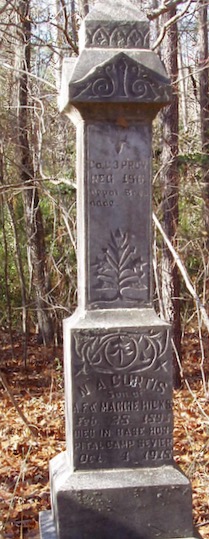
Grave stone of Neill Abner Curtis Hicks, 1897-1918

There is an old Scottish cemetery in the Sandhills of North Carolina, where the oldest grave is dated 1796. Many people buried there were from the Western Isles of Scotland, including Jura and Skye. They spoke Gaelic.  Most of the graves have the names Ferguson and McDonald on them. The last monument was a tribute to a soldier who fell in World War I, not from an enemy bullet, but from a virus, during the 1918 Influenza Pandemic.

My aunt, Willie Alexander Carr, told me of walking to the cemetery with her mother, Loula Richardson Alexander, when Willie was seven years old. They went down a lane and through the woods near the Alexanders’ farm, balancing on a log to cross the creek. They were visiting the grave of Loula’s first cousin, Curtis Hicks.

The Hicks family lived in the township of Greenwood, in Moore County, North Carolina. Abner Hicks and Margaret McDonald married in 1890, and by 1902, they had five children. Then they lost their sixth child as an infant, and two years later, after the birth of twins, Margaret died. Her babies, a boy and a girl, died soon after. Their graves were all placed beside Margaret’s parents in the old cemetery.

In 1911, Abner remarried, to Flora Ann Yow, a neighbor. My father remembered her as “Aunt Flora Ann,” beloved by the family for her kindness to her step-children.

The fourth child of Abner and Margaret, Curtis, was twenty-one when young men were drafted for the Great War. His draft card described him as dark haired and blue eyed. He worked for a local farmer, Angus Cameron, who owned a saw mill. Curtis registered in June of 1918 and left his home for Fort Jackson in August.

Curtis was assigned to Camp Sevier, built in 1917 near Greenville, S. C., to train soldiers for the war. By the Armistice in November 1918, 80,000 soldiers had passed through the large camp. In September of 1918, the first influenza case appeared in the camp hospital, and it opened a floodgate.

The epidemic developed so rapidly that facilities and staff were expanded and taxed to the limit. When the hospital filled up, the Red Cross and Y. M. C. A. buildings, the schoolhouse, a theater, mess halls, and tents became hospital wards. Medical officers were joined by civilian, professional, and practical nurses in tending to a total of 6,000 patients.

Personnel used many precautions, isolating patients with hanging sheets and screens. Doctors, nurses, and attendants wore masks and gowns. Patients with pneumonia were placed in separate wards. Disposable cups and plates were used and burned afterward.

Curtis Hicks was one of the unfortunate soldiers who developed pneumonia, which caused his lungs to hemorrhage and quickly caused his death. Three hundred and forty soldiers died, a death rate over 5% in the camp. He died on October 4, only a few months after his induction into the Army. By November 11, the epidemic, as well as the war, was effectively over.

Curtis was buried near his mother and his grandfather, John Finlayson McDonald. Willie and Loula visited the grave when fresh soil was still mounded over it. Woods now cover the acre of old family graves, and real estate development has slowly surrounded it.

Copyright 2020 by Glenda Alexander. All rights reserved.

Sources:

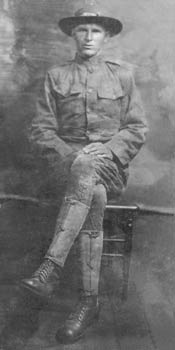
wwI_soldier

Willie D. Richardson, cousin of Curtis Hicks, WWI

1900 U. S. Census, McNeill’s Tshp., Moore County, N. C., p. 169; NARA Microfilm T623-1207; 1910 U. S. Census, McNeill’s Tshp., Moore County, N. C., p. 193; NARA Microfilm T624-1119; 1920 U. S. Census, Vass, Moore County, N. C., E. D. 92, p. 21B; NARA Microfilm T625-1300; accessed on Ancestry.com.

North Carolina, Marriage Records, 1741-2011 [database on-line]. Provo, UT, USA: Ancestry.com Operations, Inc., 2015. Original data: North Carolina County Registers of Deeds. Microfilm. Record Group 048. North Carolina State Archives, Raleigh, NC.

U.S., World War I Draft Registration Cards, 1917-1918 [database on-line]. Provo, UT, USA: Ancestry.com Operations Inc, 2005.;

South Carolina Death Records, 1821-1955 [database on-line]. Provo, UT, USA: Ancestry.com Operations Inc, 2008. Original data: South Carolina. South Carolina death records. Columbia, SC, USA: South Carolina Department of Archives and History.

Influenza Outbreak of 1918-1919, by Steve Case, revised by Lisa Gregory, 2010, NC Government and Heritage Library, NCPedia.com. Accessed 7 March 2020.

U.S., Lists of Men Ordered to Report to Local Board for Military Duty, 1917–1918 [database on-line]. Original data: War Department, Office of the Provost Marshal General, Selective Service System, 1917– 07/15/1919. National Archives at College Park. College Park, Maryland.

Office of Medical History: Office of the Surgeon General, “Extracts from Reports Relative to Influenza, Pneumonia, and Respiratory Diseases,” April 4, 2003, http://history.amedd.army.mil/booksdocs/wwi/1918flu/ARSG1919/ARSG1919Extractsflu.htm#U1. (continued)%20CAMP%20SEVIER%20BASE%20HOSPITAL%20REPORT, accessed March 9, 2020.

Grave monument in McDonald-Ferguson family cemetery, off County Road 1825, approx. .4 mile from Highway 1, just north of Crains Creek, Moore County. Visit to cemetery and photographs taken March 29, 2002.

Interviews with Willie Alexander Carr and Lewey G. Alexander, Sr., by the author, April 1, 2002.

If my great-grandmothers were alive today…

Post Script to my post on great grandmothers–

I love what KristenLynn Writes on her blog:

“If our Great-Grandmothers would’ve had Facebook and Twitter when they were young mothers…”

This is hilarious…mostly.  “#roughtimes”

https://kristenlynnwrites.wordpress.com/2014/03/04/if-our-great-grandmothers-wouldve-had-facebook-and-twitter-when-they-were-young-mothers/

My grandmother Loula & her sister, Pearl, when they were young mothers.

Copyright 2018 by Glenda Alexander.  All rights reserved.

International Women’s Day: Honoring My Great-Grandmothers

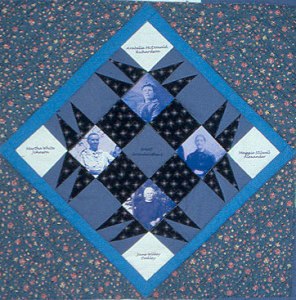
This is a quilt honoring my four great-grandmothers.

Left:  Martha Frances White Johnson (1862-1933) claimed Native American ancestry, and her maternal grandmother was said to have come from the Powhatan Reservation.

Right:  Margaret Matilda Stillwell Alexander (1847-1931) was an identical twin. She startled the neighbors at her sister’s funeral. Her husband was also a twin.

Top:  Mary Arabella McDonald Richardson (1867-1935) was the grand-daughter of immigrants from the Western Isles of Scotland. She loved to walk on her land in the Sandhills.

Bottom:  Margaret Jane Willey Oakley (1858-1934) gathered wild herbs for a living and ran the farm after her husband’s death. Her six children were all boys.


Copyright 2018 by Glenda Alexander.  All rights reserved.

Valentine’s Day

How did your grandparents meet?  You might find clues in the census.

William Franklin Alexander married Loula Isabella Richardson on July 13, 1910, in Moore County, N. C.  (On the left is their wedding portrait.)  In May of that year, the census said he operated a shingle mill and was a boarder in the John D. Richardson household.  John Richardson was a farmer, and other records indicate that he  owned a saw mill.  His daughter Loula and her sisters were employed on the farm at the occupation of “chopping,” while their brothers did plowing.  Adjacent to the Richardson household on the census page was George Morgan, who was a laborer in the shingle mill.  In the same year, Loula’s sister Pearl would elope with George.  Two of her nieces told me that she slipped out of the house at night, with the help of some female cousins of the McDonald family.  George drove his buggy to Virginia, where they married across the state line.

Like many contemporary couples, these people met at work.  The shingle mill was located on the farm, and Frank actually lived in the household of his future wife.

Last fall, at the North Carolina State Fair, I saw a steam-powered saw mill in operation, which was probably similar to the one used by Frank and George for cutting wooden shingles for roofs and siding for buildings.

Source:  1910 U. S. Census, Greenwood Township, Moore County, N. C., E. D. 7, p. 9A; Family Bible records of the Alexander family in possession of Glenda Alexander.

Copyright 2018 by Glenda Alexander.  All rights reserved.

Of Astronomy

When Jeremiah Mobley (1744-1826, Edgefield, S. C.) and his family read his copy of the Self-Instructor, they might have been led to believe that there was life on Mars and other planets. In the section on Astronomy, the “most sublime of all the sciences,” they would have read that Mars “has a considerable, but moderate atmosphere, so that its inhabitants probably enjoy a situation, in many respects, similar to ours.”

The sun was described as a “large and lucid planet,” solid, with an atmosphere and with mountains and valleys on its surface. Therefore, it was deducted that “it is most probably inhabited, like the rest of the planets, by beings whose organs are adapted to the peculiar circumstances of that vaster globe.” The Instructor explained how, by logic, the sun must have areas, like mountain tops, which would have cooler temperatures that would not “scorch up” everything on them. His knowledge of the approximate diameter of the sun and its size relative to the Earth’s size were pretty accurate, even though he underestimated its heat.

Astronomy was defined as the science concerning the motions of planets and stars. The Instructor explained how observation and logic determined that the earth was a sphere, and how scholars had debated whether the earth or the sun was the center of the universe.

The Mobleys may have consulted the book when they experienced the Great Comet of 1811, which presumably they and the rest of the world could see in the sky for the better part of a year, without a telescope. The Self-Instructor told them that comets remain in the sky for hundreds of years, and after fading out of sight, they will reappear to future generations. The Astronomy chapter also covered the topics of tides, eclipses, and stars, describing constellations and the Milky Way.

Astrology, however, was called a “malady of weak minds,” as the stars were considered to be too far away to influence human lives. Also, to know the future would destroy human confidence and motivation. Furthermore, the Instructor asserted that only “the light of science…can free us from the gross impositions of these wretched empiricks.” (An empiric being someone who believes in only what they can observe for themselves, as opposed, perhaps, to someone who believes, based on theory, that people live on the sun.)

On the other hand, farming according to the sun signs was a useful thing, as was telling time and navigating by the stars. Also important was the spiritual value of contemplating the vastness of the universe, enhanced by the elegant planetarium illustrated.

Sources: E. MacKenzie, The Self-Instructor; or Young Man’s Best Companion: Being a New, Sure, and Easy Guide to Knowledge, Virtue, and Happiness (Newcastle Upon Tyne: MacKenzie and Dent, 1827) pp. 263-290; “Great Comet of 1811,” Wikipedia, https://en.wikipedia.org/wiki/Great_Comet_of_1811, accessed 9 Feb. 2018, last edited on 6 February 2018.

Copyright 2018 by Glenda Alexander.  All rights reserved.


The Self-Instructor

SelfInstructor001 copyThis book was listed in the estate inventory of Jeremiah Mobley, who died in 1826 in Edgefield County, S. C. Jeremiah’s assets also included a wagon, livestock, furniture, and shoemakers’ tools. Estate inventories can have great clues as to the occupation and prosperity of an individual.
Young Man’s Companion was first published in England in 1731 and published in New York for the American colonies in 1770. It is a book of general, practical knowledge and instruction in everything from reading and writing to medicine and business, a sort of encyclopedia. This edition, published a year after Jeremiah’s death, contains over 600 pages of information and a few very fine illustrations.

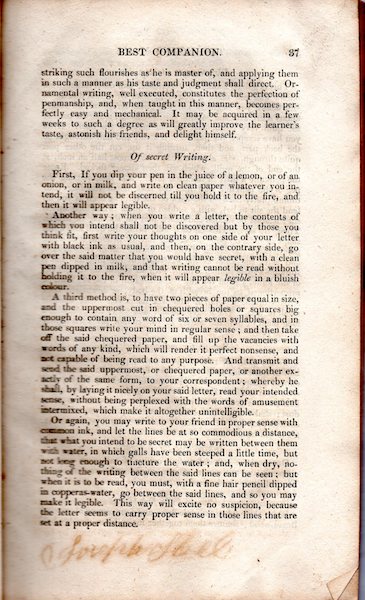
secret writing002


This page deals with secret writing, in case a person wanted to write a message for the eyes of a select audience. The owner of this copy obviously tried one of the methods on the page itself. I’m guessing it was the lemon juice trick, having tried that myself in Girl Scouts.

Literacy and education were not available free to the public in Jeremiah Mobley’s time, so a book of self-instruction would have been valuable enough to leave in a will, had he made one.

Jeremiah’s son James Mobley lived in Siler City, N. C. and was a shoemaker. Among his descendants are Pyrena Mobley, who married William H. H. Richardson in Chatham County in 1866. They were the parents of John Dolphus Richardson who settled in Moore County.

Copyright 2018 by Glenda Alexander.  All Rights Reserved.